


Prediction: Nvidia Stock Is Going to Soar After May 20
Key Points
Nvidia supplies the best data center chips for processing AI workloads, and demand continues to outstrip supply.
The company will report its operating results for its fiscal 2027 first quarter on May 20, likely showing accelerating revenue growth.
Nvidia stock is trading at a very attractive level heading into the report, leaving plenty of room for upside.
- 10 stocks we like better than Nvidia ›
Nvidia (NASDAQ: NVDA) supplies the world's best graphics processing units (GPUs) for data centers, which are the primary chips used in artificial intelligence (AI) development. Sales have been so strong that the company's valuation has ballooned from $360 billion to $4.8 trillion since the start of 2023, but there might be even more upside ahead.
Nvidia is scheduled to release its operating results for its fiscal 2027 first quarter (ended April 30) on May 20, and considering some of the company's biggest data center customers have recently increased their AI infrastructure spending forecasts, I think the report could be a major upside catalyst for its stock.
Will AI create the world's first trillionaire? Our team just released a report on the one little-known company, called an "Indispensable Monopoly" providing the critical technology Nvidia and Intel both need. Continue »

Image source: Nvidia.
Nvidia's fastest-ever chips are about to start shipping
Nvidia's Blackwell GB300 GPUs are the most sought-after data center chips in the AI industry. In certain configurations, they offer up to 50 times the performance of the company's original Hopper H100 GPUs, a huge leap given that the two generations are separated by just three years.
But Nvidia unveiled its new Vera Rubin platform last year, which includes the Rubin GPU, the Vera CPU, the latest NVLink 6 switches, and other networking components. Management says it will be so powerful that AI models can be trained with 75% fewer GPUs than on the Blackwell platform, translating to a 90% reduction in inference token costs.
Inference tokens are the text, images, or videos generated by an AI model in response to a user's prompts. They are expensive to produce because AI consumes so much computing capacity, which is why data center operators typically charge customers based on usage. But if Rubin GPUs bring costs down by 90%, those operators can charge far less while maintaining -- or even increasing -- their profit margins.
The net result could be more AI usage overall, driving higher demand for Nvidia's chips. According to CEO Jensen Huang's last update, the Vera Rubin platform will start shipping in commercial quantities in the second half of this year. However, investors should keep an eye out for any updates to the timeline in Huang's commentary on May 20.
Nvidia's first-quarter results could be spectacular
Nvidia generated $215.9 billion in total revenue during fiscal 2026 (ended Jan. 25), which was a 65% increase from the prior year. The data center segment alone accounted for $193.7 billion of that revenue, which emphasizes how important GPU sales are to the company overall.
Management forecast $78 billion in revenue for the first quarter of fiscal 2027, representing an accelerated growth rate of 77%. That would be a great result as it stands, so any kind of beat on May 20 would be a positive for Nvidia stock.
Investors will also be looking at the company's forward guidance on May 20. According to Yahoo! Finance, Wall Street expects Nvidia's management team to forecast $86.6 billion in revenue for the fiscal 2027 second quarter, which would mark a further acceleration in growth to 85%.
But some of Nvidia's top customers recently raised their capital expenditures (capex) forecasts for this year, factoring in higher GPU and component prices than originally expected. Meta Platforms raised the high end of its capex guidance range from $135 billion up to $145 billion. Microsoft also announced $190 billion in planned capex for calendar year 2026, well above the $154 billion Wall Street had anticipated.
As a result, analysts' forward revenue estimates for Nvidia might prove too low.
Nvidia stock is attractively valued heading into May 20
Nvidia generated adjusted (non-GAAP) earnings of $4.77 per share in fiscal 2026, placing its stock at a price-to-earnings (P/E) ratio of 40.5. That's a steep discount to its 10-year average P/E ratio of 61.7, which suggests the stock might be undervalued right now.
Moreover, Wall Street expects the company will grow its earnings to $8.34 per share during fiscal 2027, placing its stock at a forward P/E ratio of just 23.8.
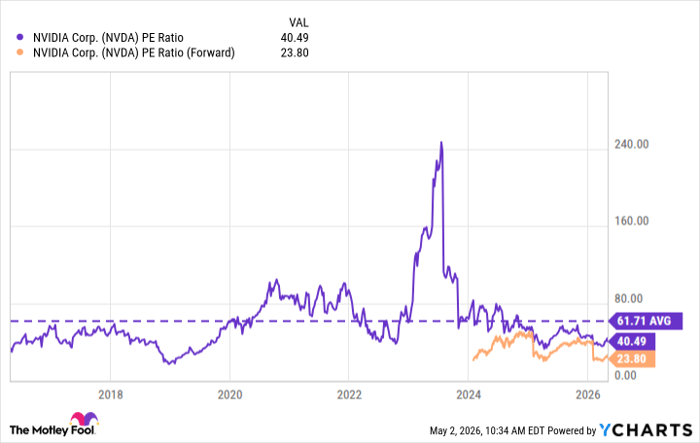
Data by YCharts.
That suggests Nvidia stock would have to soar by 70% over the next 12 months just to maintain its current P/E ratio of 40.5, and by a whopping 159% to trade in line with its 10-year average P/E of 61.7.
The company's first-quarter results on May 20 could set the tone for the rest of fiscal 2027. If the report shows stronger sales and higher forward guidance than expected, analysts will likely have to increase their estimates, making the stock look even cheaper at the current price. I think that is the likely outcome, since AI infrastructure spending shows no signs of slowing.
Should you buy stock in Nvidia right now?
Before you buy stock in Nvidia, consider this:
The Motley Fool Stock Advisor analyst team just identified what they believe are the 10 best stocks for investors to buy now… and Nvidia wasn’t one of them. The 10 stocks that made the cut could produce monster returns in the coming years.
Consider when Netflix made this list on December 17, 2004... if you invested $1,000 at the time of our recommendation, you’d have $490,864!* Or when Nvidia made this list on April 15, 2005... if you invested $1,000 at the time of our recommendation, you’d have $1,216,789!*
Now, it’s worth noting Stock Advisor’s total average return is 963% — a market-crushing outperformance compared to 201% for the S&P 500. Don't miss the latest top 10 list, available with Stock Advisor, and join an investing community built by individual investors for individual investors.
See the 10 stocks »
*Stock Advisor returns as of May 5, 2026.
Anthony Di Pizio has no position in any of the stocks mentioned. The Motley Fool has positions in and recommends Meta Platforms, Microsoft, and Nvidia. The Motley Fool has a disclosure policy.
Recommended Articles


