


Did President Donald Trump Just Outsmart Wall Street? The U.S. Government Just Made $34 Billion on a Legacy Tech Stock That Had Been Left for Dead.
Key Points
The U.S. government has historically been more prone to invest in companies when they were on the brink of collapse and when there were ramifications for the broader economy.
Trump has had the government take positions in companies he considers vital to national economic security.
Recently, one of the government's positions has seen its stock soar.
- 10 stocks we like better than Intel ›
Since the start of his second term, President Donald Trump's administration has had the U.S. government take an equity stake in at least 10 companies. While the government has taken equity stakes before, it has historically been done as a last resort when a company looks like it could be going out of business and keeping it afloat is viewed to be in the national interest.
Most of the government's stakes over the past year have been in companies dealing with critical natural resources that the administration sees as vital to the economy.
Some of the government's positions have performed quite well since it took a stake. Did Trump just outsmart Wall Street? The government has made roughly $34 billion on a company that not long ago had been viewed as a legacy tech company left for dead.
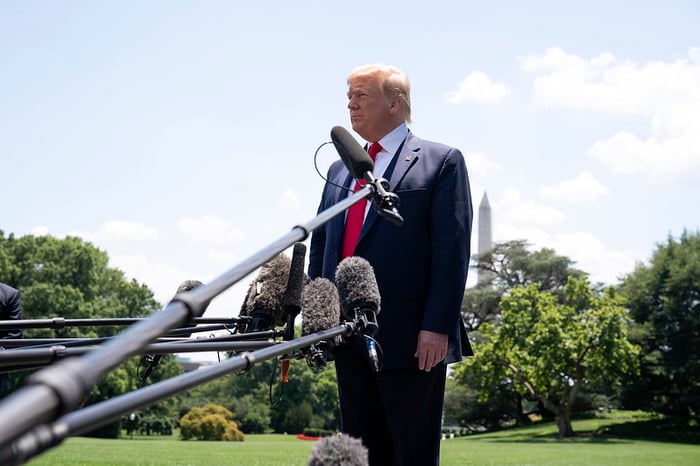
Image source: Joyce N. Boghosian.
Continuing his push to reshore manufacturing
A key policy goal of the Trump administration has been to bring back higher-paying manufacturing jobs to the U.S. These efforts have been ongoing since Trump's first term, but seemed to be an even clearer priority in Trump's second term.
It began with "Liberation Day" in early April of 2025, when Trump imposed high tariff rates on virtually all of the key trading partners of the U.S. While many of the initial tariffs have been undone, due to a Supreme Court ruling, Trump has found other ways to implement tariffs, such as a 10% global import surcharge imposed after the Supreme Court ruling that will be in effect until at least July 24 of this year.
Additionally, Trump has put pressure on large tech companies like Apple and Nvidia to either give the U.S. a share of their international sales or commit to building more factories in the U.S.
One company that came under scrutiny last year was Intel (NASDAQ: INTC). Trump expressed frustration with CEO Lip-Bu Tan, alleging that Tan had invested in companies associated with the Chinese military.
However, following these issues, Trump and Tan met, and a few weeks later, the government and Intel issued a joint statement announcing that the government would invest in the company. The U.S. invested a total of $11.1 billion, while Intel committed to ensuring its tech would be American-made.
The $11.1 billion investment came from several sources, including $5.7 billion that the company had previously been awarded under the U.S. CHIPS and Science Act but had not yet received. An additional $3.2 billion was awarded to the company from the government's Secure Enclave program. And Intel had already received $2.2 billion from the CHIPS Act, bringing the total investment to $11.1 billion.
Per the agreement, the U.S. government purchased 433.3 million shares of Intel common stock at an average price of $20.47 per share, representing nearly $8.9 billion and a 9.9% stake in the company at the time. After executing a strong turnaround and recently delivering strong earnings, Intel now trades at close to $100 per share (as of May 2).
The position is now worth close to $43.3 billion, meaning the government has made roughly $34.5 billion on its stake.
Did Trump outsmart Wall Street?
The market has bid up stocks in which the government has announced stakes. It makes sense because Wall Street views a government stake essentially as a backstop, to some degree, in case things go wrong at the company. The government may also be able to help Intel in other ways, such as through future government business or grants.
However, Intel's run can really be attributed to the growing popularity of central processing units (CPUs), which are the more standard chips that help power laptops and cellphones. Until recently, the artificial intelligence revolution seemed to be all about graphics processing units (GPUs). Intel does make some GPUs and has ambitions to develop ones for data centers, but it has not yet been considered a serious player in GPUs.
However, it is one of the best at CPUs, which the company not only designs but also manufactures, controlling the entire stack. CPUs have become a big part of the AI story because they are instrumental in executing tasks performed by AI agents. The CPUs help the AI agents orchestrate these tasks, whether it's pulling data from a web page, executing a workflow, or formatting data before sending it to the GPUs.
Agentic AI looks to be the future, meaning CPUs have a big part to play. Whether the Trump administration saw that before the investment, I'm not sure. But that investment has certainly paid off.
Should you buy stock in Intel right now?
Before you buy stock in Intel, consider this:
The Motley Fool Stock Advisor analyst team just identified what they believe are the 10 best stocks for investors to buy now… and Intel wasn’t one of them. The 10 stocks that made the cut could produce monster returns in the coming years.
Consider when Netflix made this list on December 17, 2004... if you invested $1,000 at the time of our recommendation, you’d have $496,473!* Or when Nvidia made this list on April 15, 2005... if you invested $1,000 at the time of our recommendation, you’d have $1,216,605!*
Now, it’s worth noting Stock Advisor’s total average return is 968% — a market-crushing outperformance compared to 202% for the S&P 500. Don't miss the latest top 10 list, available with Stock Advisor, and join an investing community built by individual investors for individual investors.
See the 10 stocks »
*Stock Advisor returns as of May 5, 2026.
Bram Berkowitz has no position in any of the stocks mentioned. The Motley Fool has positions in and recommends Apple, Intel, and Nvidia. The Motley Fool has a disclosure policy.
Recommended Articles


