


Did Polaris Just Turn Into a Drone Stock?
Key Points
ATV maker Polaris beat analyst forecasts this week -- but still lost a lot of money.
2026 sales could flatline, but a new business manufacturing ground drones with Forterra might reignite sales growth.
- 10 stocks we like better than Polaris ›
This week was a good week to own Polaris (NYSE: PII) stock -- and the next 52 weeks could be even better.
The manufacturer of everything from snowmobiles to motorcycles to all-terrain vehicles to boats reported first-quarter earnings on Tuesday, you see, crushing analyst forecasts and reporting a $0.13-per-share profit where Wall Street expected a loss of $0.40. Quarterly sales exceeded expectations as well, growing 8% year over year to $1.7 billion, and Polaris expanded its gross profit margin by 420 basis points to 20.2%.
Will AI create the world's first trillionaire? Our team just released a report on the one little-known company, called an "Indispensable Monopoly" providing the critical technology Nvidia and Intel both need. Continue »
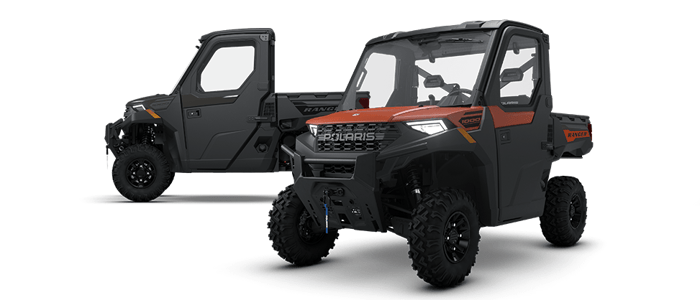
Polaris builds ATVs -- now also for the U.S. military. Image source: Polaris.
Wall Street reacts
Analysts praised the results, and no fewer than six separate analysts raised their price targets on Polaris stock to between $60 a share (the most pessimistic, Wells Fargo) and $74 a share (the most optimistic -- Bank of America). Curiously, though, almost all of these analysts (the exception being Raymond James) maintained only neutral or hold ratings on Polaris stock.
The news might have been good enough to win some price target hikes -- but it wasn't good enough to convince most analysts to buy Polaris stock.
Why not?
The trouble with Polaris
Two factors may explain this. First and foremost, while Polaris "beat earnings" and reported positive non-GAAP (adjusted) profits, its actual earnings per share calculated under generally accepted accounting principles (GAAP) showed an $0.83-per-share loss for the quarter.
Second and related, Polaris guided investors to expect essentially zero sales growth through the end of this year. Sales are expected to be about $7.2 billion in 2026 -- the same as in 2025. For Polaris to win higher ratings from Wall Street and more investor support, it seems the company must find a way to grow its sales faster.
Fortunately, Polaris may have a plan for that -- and it comes from an unexpected direction.
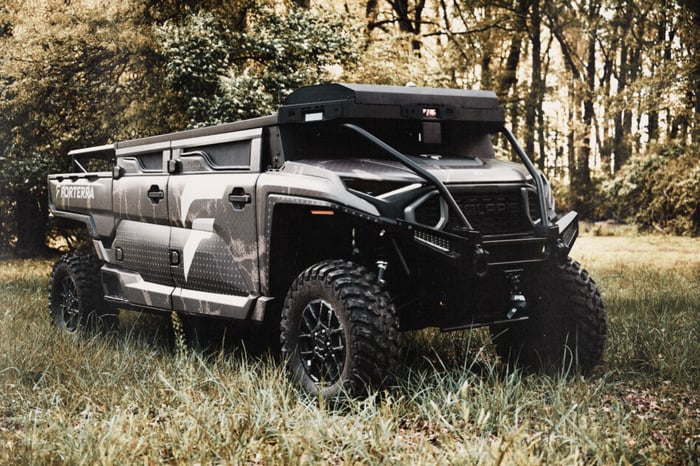
Image source: Forterra.
Uncle Sam wants Polaris
Earlier this week, Maryland-based defense start-up Forterra unveiled the new Mesa Autonomous Ground Vehicle (essentially a drone truck, rather than a drone aircraft) that it's developing for the U.S. Army -- with help from Polaris.
Guided by software and capable of maneuvering autonomously even in areas where GPS signals are jammed, Mesa, according to Forterra, is based on a "factory modified Polaris Ranger XD 1500 all-terrain vehicle."
Although the photo Forterra provided shows Mesa to be about twice as long as a base Ranger XD 1500, Forterra explains that Mesa is "built in direct partnership with Polaris" and that "every vehicle comes off the same market-leading production line that delivers" Polaris's other vehicles.
Translation: Forterra is working with Polaris to build this new military robot. The more successful Forterra is in selling it, the more it will directly benefit Polaris through improved sales and (ideally) a return to positive profits.
Keep an eye on Forterra
As for Polaris's partner in this venture, investors might also want to keep a close eye on Forterra, which is starting to seem like a real up-and-comer (even if most people have never heard of it).
Defense website Tectonic calls Forterra "a giant in the ground autonomy game" and earning praise for its AutoDrive vehicle autonomy system, which includes all the hardware, software, and sensors necessary to convert essentially any existing vehicle into an autonomous ground drone. In addition to Polaris, Forterra has also teamed up with big-league defense contractors such as BAE Systems, General Dynamics, Oshkosh, and Rheinmetall in Germany to produce autonomous ground vehicles.
The company also recently hit unicorn status, raising hundreds of millions in venture capital financing and achieving a private market valuation of $1.1 billion. With any luck, an initial public offering may not be too far off.
Should you buy stock in Polaris right now?
Before you buy stock in Polaris, consider this:
The Motley Fool Stock Advisor analyst team just identified what they believe are the 10 best stocks for investors to buy now… and Polaris wasn’t one of them. The 10 stocks that made the cut could produce monster returns in the coming years.
Consider when Netflix made this list on December 17, 2004... if you invested $1,000 at the time of our recommendation, you’d have $496,473!* Or when Nvidia made this list on April 15, 2005... if you invested $1,000 at the time of our recommendation, you’d have $1,216,605!*
Now, it’s worth noting Stock Advisor’s total average return is 968% — a market-crushing outperformance compared to 202% for the S&P 500. Don't miss the latest top 10 list, available with Stock Advisor, and join an investing community built by individual investors for individual investors.
See the 10 stocks »
*Stock Advisor returns as of May 3, 2026.
Bank of America is an advertising partner of Motley Fool Money. Wells Fargo is an advertising partner of Motley Fool Money. Rich Smith has no position in any of the stocks mentioned. The Motley Fool recommends BAE Systems. The Motley Fool has a disclosure policy.
Recommended Articles


