


President Donald Trump Is the Catalyst Behind This $7 Trillion Investment That's Fueled Wall Street's Bull Market (Hint: It's Not AI)
Key Points
The Dow Jones Industrial Average, S&P 500, and Nasdaq Composite have generated outsize returns under President Trump.
The Tax Cuts and Jobs Act, passed during Trump's first term in office, slashed the peak marginal corporate income tax rate to 21% -- its lowest level since 1939 -- and fueled share buybacks.
However, this $7 trillion investment may have met its match.
- 10 stocks we like better than S&P 500 Index ›
In case you haven't noticed, the bulls have ruled the roost on Wall Street for years. Aside from the five-week COVID-19 crash in February-March 2020 and the nine-month bear market in 2022, the time-honored Dow Jones Industrial Average (DJINDICES: ^DJI), benchmark S&P 500 (SNPINDEX: ^GSPC), and innovation-inspired Nasdaq Composite (NASDAQINDEX: ^IXIC) have rallied with consistency since President Donald Trump took office for his first, non-consecutive term in January 2017.
During Trump's first term, the Dow, S&P 500, and Nasdaq gained 57%, 70%, and 142%, respectively. This has been followed by double-digit gains across all three indexes since his second term began on Jan. 20, 2025.
Will AI create the world's first trillionaire? Our team just released a report on the one little-known company, called an "Indispensable Monopoly" providing the critical technology Nvidia and Intel both need. Continue »
While most investors would attribute these outsize returns to the rise of artificial intelligence (AI), there's an even larger investment, spurred by President Trump, responsible for sending the Dow, S&P 500, and Nasdaq Composite to new heights.
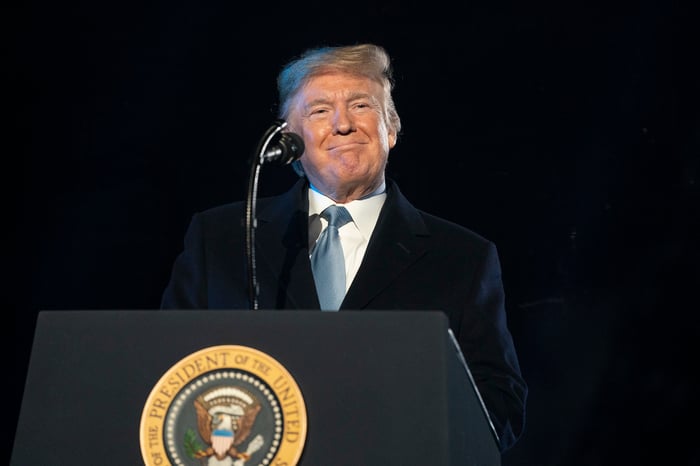
President Trump delivering remarks. Image source: Official White House Photo by Joyce N. Boghosian, courtesy of the National Archives.
Donald Trump's flagship tax and spending law has fueled share buybacks
Over the last year, investors have paid close attention to Trump's tariff and trade policy, the implications of the Iran war, and the ramifications of the "Big, Beautiful Bill" becoming law. While the Big, Beautiful Bill is still fresh in everyone's mind, it's the president's flagship tax and spending law from his first term that really sparked Wall Street's bull market rally.
The Tax Cuts and Jobs Act (TCJA), signed into law by President Trump in December 2017, completely changed the game for corporate America. It permanently lowered the peak marginal corporate income tax rate from 35% to 21% (the lowest since 1939).
In lowering the corporate income tax rate, Trump hoped to light a fire beneath the U.S. economy. A lower corporate income tax rate would allow businesses to retain more of their earnings, which could then be used to boost hiring, facilitate acquisitions, and promote innovation.
But the TCJA led to another type of boom: share buybacks.
S&P 500 buybacks were $249.0b in 3Q25, up 6.2% from 2Q25 and up 9.9% from 3Q24; top 20 S&P 500 companies accounted for 49.5% of 3Q25 share repurchases, down from 51.3% in 2Q25
-- Liz Ann Sonders (@LizAnnSonders) December 19, 2025
@SPDJIndices pic.twitter.com/dwa0aikdw2
Between 2011 and 2017, S&P 500 companies repurchased between $413 billion and $592 billion of their stock annually. When the TCJA went into effect, the impact on share buybacks was night and day:
- 2018: $840 billion in S&P 500 buybacks
- 2019: $749 billion
- 2020: $538 billion
- 2021: $919 billion
- 2022: $950 billion
- 2023: $815 billion
- 2024: $943 billion
- 2025: $1.2 trillion (est.)
Collectively, S&P 500 companies have invested almost $7 trillion to repurchase their own shares since the start of 2018. This is based on a record estimate of $1.2 trillion in buybacks last year, according to research from The Motley Fool.
For companies with steady or growing net income and a declining outstanding share count, a steady diet of buybacks can increase earnings per share (EPS). Apple (NASDAQ: AAPL), for instance, has spent $841 billion to retire more than 44% of its outstanding shares since the beginning of 2013. Buybacks can amplify EPS growth and make a company's shares more fundamentally attractive to value-seeking investors.
Additionally, buybacks can incrementally increase ownership stakes for long-term investors. This is what prompted now-retired CEO Warren Buffett to deploy $78 billion for share repurchases at Berkshire Hathaway from July 2018 to June 2024.

Image source: Getty Images.
Trump's $7 trillion investment may have met its historical match
There's no question that share repurchases have played a foundational role in lifting the tide for the Dow Jones Industrial Average, S&P 500, and Nasdaq Composite. The problem for Wall Street is that historical precedent may be insurmountable.
Take the AI revolution as the perfect example. On the one hand, Wall Street's most influential businesses are spending a small fortune to build out AI data center infrastructure. The adoption of AI hardware has been swift and widespread.
However, the companies spending aggressively on AI aren't particularly close to optimizing these solutions to maximize sales and profits. Every game-changing technology for more than three decades has endured an early stage bubble-bursting event, without exception. Investors consistently overestimate the adoption and/or optimization of these game-changing trends -- and AI is unlikely to be the exception to this unwritten rule.
If an AI bubble were to form and subsequently burst, not even $1 trillion in annual buybacks would be enough to buoy the proverbial ship.
But this isn't the only historical headwind threatening to upend the Trump bull market.
The S&P 500's CAPE Ratio has moved up to 40, its highest level since 2000 and now above 99% of historical valuations. $SPX pic.twitter.com/uhUt33SCp5
-- Charlie Bilello (@charliebilello) April 20, 2026
When 2026 began, the stock market was trading at its second-highest valuation over 155 years, according to the Shiller Price-to-Earnings (P/E) Ratio (also known as the Cyclically Adjusted P/E Ratio, or CAPE Ratio). Whereas the S&P 500's Shiller P/E has averaged a little over 17 since January 1871, it began the year above 40!
History shows that Shiller P/E ratios above 30 foreshadow impending disaster for the stock market. The five previous times the CAPE Ratio exceeded 30 were eventually followed by declines of 20% to 89% in the Dow, S&P 500, and/or Nasdaq Composite. Investors don't tolerate premium valuations for long.
If history rhymes, the stock market's premium valuation multiple won't be sustainable -- even with record S&P 500 share buybacks in 2025.
While Trump's flagship tax and spending law has provided a nearly $7 trillion boost to Wall Street, there are limits to how far buybacks can boost equities.
Should you buy stock in S&P 500 Index right now?
Before you buy stock in S&P 500 Index, consider this:
The Motley Fool Stock Advisor analyst team just identified what they believe are the 10 best stocks for investors to buy now… and S&P 500 Index wasn’t one of them. The 10 stocks that made the cut could produce monster returns in the coming years.
Consider when Netflix made this list on December 17, 2004... if you invested $1,000 at the time of our recommendation, you’d have $504,832!* Or when Nvidia made this list on April 15, 2005... if you invested $1,000 at the time of our recommendation, you’d have $1,223,471!*
Now, it’s worth noting Stock Advisor’s total average return is 971% — a market-crushing outperformance compared to 202% for the S&P 500. Don't miss the latest top 10 list, available with Stock Advisor, and join an investing community built by individual investors for individual investors.
See the 10 stocks »
*Stock Advisor returns as of May 2, 2026.
Sean Williams has no position in any of the stocks mentioned. The Motley Fool has positions in and recommends Apple and Berkshire Hathaway. The Motley Fool has a disclosure policy.
Recommended Articles


