


3 Artificial Intelligence Stocks You Can Buy and Hold for the Next Decade
Key Points
Semiconductor giant Nvidia is responsible for critical hardware used in data centers.
Microsoft's vast enterprise software integration helps it instantly get its AI tools in front of millions.
CrowdStrike has a data advantage that gives it a leg up when training its AI cybersecurity models.
- 10 stocks we like better than Nvidia ›
There hasn't been a technology since the internet that has taken over the mainstream quite like artificial intelligence (AI). It has become somewhat unavoidable if you scroll through social media or pay attention to the media.The new obsession with AI has seen investors putting tons of money into AI stocks and making a lot of money along the way.
There are arguments that AI stocks are overvalued now, and undoubtedly, many companies won't stand the test of time. However, there are some AI stocks you can comfortably hold for a decade-plus without thinking twice.
Will AI create the world's first trillionaire? Our team just released a report on the one little-known company, called an "Indispensable Monopoly" providing the critical technology Nvidia and Intel both need. Continue »

Image source: Getty Images.
1. Nvidia
As of April 27, Nvidia (NASDAQ: NVDA) was the stock market's only $5 trillion company (nearly $1 trillion more than the second-most-valuable company, Alphabet). And the reason comes down to one thing: AI. Nvidia makes some of the most important hardware used in the AI ecosystem.
For data centers to function as needed for AI, they require a lot of graphics processing units (GPUs), of which Nvidia is the largest supplier. Coincidentally, Nvidia initially used GPUs for video games but later discovered that their processing power was ideal for AI training.
In its most recent quarter, Nvidia's data center revenue increased 75% year over year (YOY) to $62.3 billion (over 91% of total revenue). Just three years ago in the same quarter, its data center revenue was only $3.62 billion.
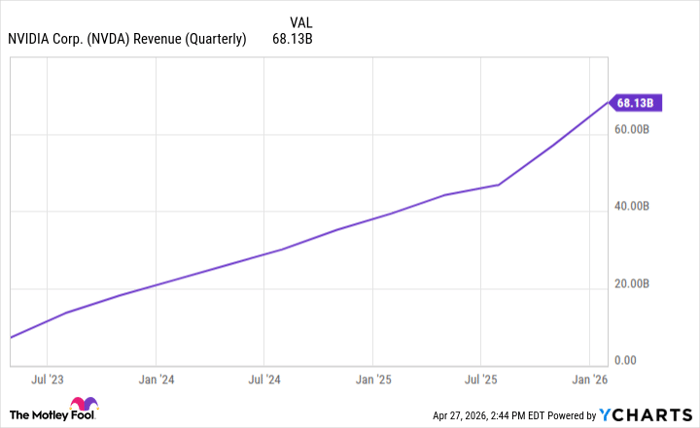
NVDA Revenue (Quarterly) data by YCharts
As AI hyperscalers like Amazon, Alphabet, and Microsoft (NASDAQ: MSFT) continue to spend on building data centers and other AI infrastructure, Nvidia is in a good spot to benefit. Its AI chips should remain in high demand.
Companies like Amazon, Alphabet, and Meta Platforms are beginning to make their own AI chips, so Nvidia's virtual monopoly on AI hardware won't last for the next decade. However, it should continue to dominate the market. Even with meaningful progress, it will be hard for competitors to catch up to Nvidia's ecosystem.
2. Microsoft
With Microsoft, you're getting a full-stack AI company. It has data centers and physical infrastructure that few tech companies can compete with, the world's second-largest cloud platform (Azure), and AI tools used by millions. Investors have punished the stock a bit this year because of Microsoft's lofty spending plans, but it's being diligent about not falling behind in the AI arms race. So far, so good.
In the AI ecosystem, Amazon and Alphabet may be able to compete with Microsoft in the cloud and AI chip markets. But one area where nobody compares to Microsoft is in enterprise software. Its tools are integrated into millions of businesses globally, acting as instant distribution that other companies can't replicate.
Microsoft's Copilot AI tools haven't had the adoption that it probably would like, but they have around 15 million paying corporate users. Tools from companies like Anthropic's Claude may outperform in specific niches or tasks, but Microsoft still reigns supreme in broad enterprise integration.
Regardless of how the AI boom turns out, Microsoft is one of the most well-diversified tech companies you'll find. Its business will be a powerhouse regardless, and one you won't have to question over the next decade.
3. CrowdStrike
CrowdStrike (NASDAQ: CRWD) is one of the pioneers of AI-first cybersecurity. What started as a single platform has grown into 33 different modules (what CrowdStrike calls its individual solutions). At the end of its latest quarter (ended Jan. 31), 24% of its customers used at least eight modules, and 50% used at least six.
Cybersecurity has become increasingly important over the years as the world has become more digitally connected, and this importance will only increase. CrowdStrike expects its total addressable market to increase from $149 billion this year to $325 billion in 2030. A decade from now, I'd expect it to be much higher, with CrowdStrike's impressive revenue growth continuing on a similar trajectory.
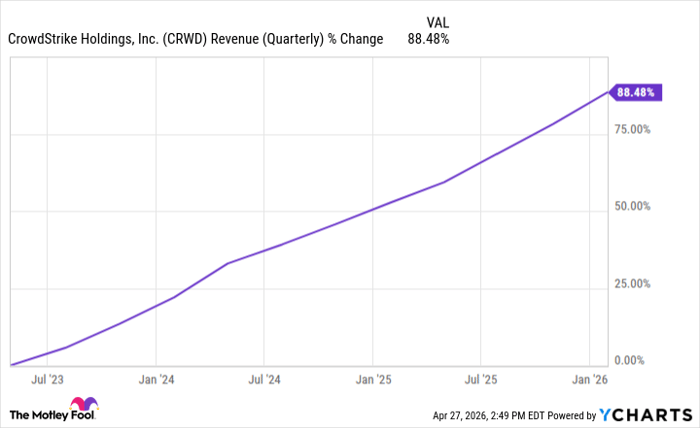
CRWD Revenue (Quarterly) data by YCharts
There's no shortage of cybersecurity companies to choose from today, but CrowdStrike's main competitive advantage is being ahead of the AI cybersecurity curve. It has spent years gathering trillions of data points that it uses to finetune its tools. That can't be readily replicated.
Over the next decade, I expect CrowdStrike to continue being a premier cybersecurity company. If it continues to attract large corporations and become more ingrained in their IT and cloud infrastructure, it will be much harder for customers to jump ship. That's a key to sustained success.
Should you buy stock in Nvidia right now?
Before you buy stock in Nvidia, consider this:
The Motley Fool Stock Advisor analyst team just identified what they believe are the 10 best stocks for investors to buy now… and Nvidia wasn’t one of them. The 10 stocks that made the cut could produce monster returns in the coming years.
Consider when Netflix made this list on December 17, 2004... if you invested $1,000 at the time of our recommendation, you’d have $496,797!* Or when Nvidia made this list on April 15, 2005... if you invested $1,000 at the time of our recommendation, you’d have $1,282,815!*
Now, it’s worth noting Stock Advisor’s total average return is 979% — a market-crushing outperformance compared to 200% for the S&P 500. Don't miss the latest top 10 list, available with Stock Advisor, and join an investing community built by individual investors for individual investors.
See the 10 stocks »
*Stock Advisor returns as of April 30, 2026.
Stefon Walters has positions in CrowdStrike and Microsoft. The Motley Fool has positions in and recommends Alphabet, Amazon, CrowdStrike, Meta Platforms, Microsoft, and Nvidia. The Motley Fool has a disclosure policy.
Recommended Articles


