


What is a Contract for Difference (CFD)?
A Contract for Difference (CFD) is a financial derivative that enables traders to speculate on the price movements of various underlying assets, including forex pairs, shares, commodities, indices, and cryptocurrencies.
When you trade a CFD, you enter into an agreement with your broker to exchange the difference in value of the underlying asset from the time you open the contract until you close it.
It's important to note that with CFDs, you do not gain ownership of the underlying asset, nor do you physically exchange currencies. Instead, you either receive or pay the difference based on the asset's price movement, depending on whether your trade is profitable or not.
Trading Strategies with CFDs
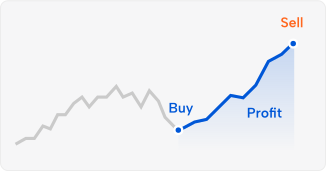
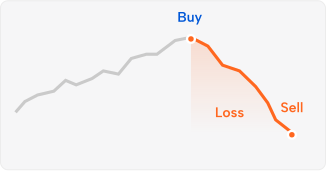
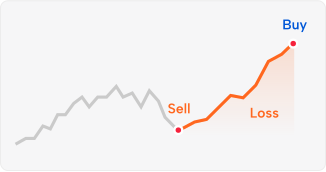
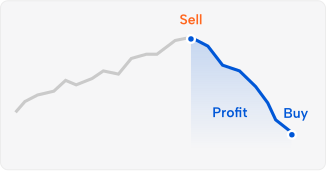
With CFDs, traders have the flexibility to take advantage of market movements by going long (buying) to profit from rising markets or going short (selling) to profit from falling markets.
Long Position (Buy)
If you anticipate that the price of an underlying asset will rise, you can open a long (buy) CFD position with the aim of closing it at a higher price. Your position will be profitable if the asset’s price increases, while you will incur a loss if the price moves against you.
Short Position (Sell)
Conversely, if you believe that the price of an underlying asset will decline, you can open a short (sell) CFD position with the intention of buying it back at a lower price. In this case, your position will be profitable if the asset’s price falls. However, if the price rises, you may incur a loss.
What Can You Trade with CFDs?
With CFDs, you have access to a wide range of markets, allowing you to diversify your trading portfolio. You can trade:
• Forex (FX): Major currency pairs like EUR/USD, GBP/USD, and USD/JPY.
• Shares: Individual stocks such as Apple (AAPL), Amazon (AMZN), and Tesla (TSLA).
• Indices: Popular indices like the Nasdaq 100, S&P 500 (SPY), and FTSE 100.
• Commodities: Key commodities such as Gold (XAU/USD), Silver (XAG/USD), and Crude Oil (WTI).
• Cryptocurrencies: Major cryptocurrencies like Bitcoin (BTC), Ethereum (ETH), and Ripple (XRP).
This variety allows you to capitalize on different market trends and conditions.
What is the duration of a CFD contract?
CFDs (Contracts for Difference) typically do not have a fixed contract length. They are open-ended, meaning the contract remains active until the trader decides to close the position. However, the broker may close the contract in certain situations, such as during margin calls.
• This flexibility allows traders to maintain their positions for as long as they choose, provided they meet any margin requirements.
Leverage
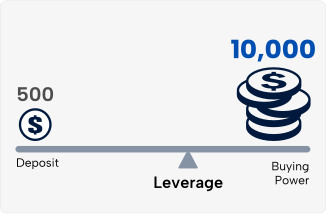
Trading CFDs involves the use of leverage. This means that you only need to have a portion of the value of your trade.
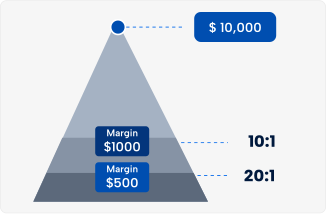
CFDs are also leveraged, which means you can take on a bigger position with a smaller amount of initial capital. In other words, you only put down a deposit of the value of your trade and borrow the remainder from your broker.
Leveraged trading is also referred to as trading on margin. This is because the funds required to open and maintain a position – known as the margin – are only a fraction of the total trade size.
Margin
Understanding Margins in Trading
What Are Margins?
Margins allow you to trade with leverage, meaning you can control a larger position in the market with a smaller amount of capital. By only putting down a percentage of the total trade value, you gain full exposure to the instrument you’re trading. However, while this can amplify profits, it also increases your risk. If the market moves against your position, you’re still responsible for the full value of that trade.
Initial Margin
The Initial Margin is the upfront amount required to open a leveraged position. It acts as a security for the broker. For example, with a 5% Initial Margin requirement, a $100 investment allows you to control a $2,000 position at 1:20 leverage. This means you could capture 100% of the profits, but losses can also be significant. When a position is opened, the Initial Margin is deducted from your Available Funds, but your total Equity remains unchanged. The formula is:
Available Funds = Equity - Initial Margin
Maintenance Margin
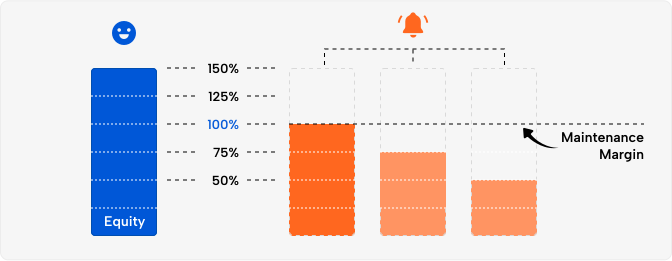
The Maintenance Margin is the minimum amount of equity you must maintain to keep your positions open. This is typically lower than the Initial Margin. For example, if your Initial Margin is 5%, you may only need to keep 2.5% of the trade value as your Maintenance Margin.
If your equity falls close to this Maintenance Margin, you risk a Margin Call, where your broker will require you to add more funds to your account or close some positions to meet the minimum requirement.
Let’s say you have $2,000 available in your account and decide to open two positions, both requiring an Initial Margin of $1,000. After opening these trades, your Available Funds will drop to $0, but your Equity will remain at $2,000.
As the market fluctuates, your equity will change, but as long as it stays above the combined Maintenance Margins of $1,000 ($500 for each position), your trades will remain active.
What Is a Margin Call?
A Margin Call occurs when your equity falls below the required Maintenance Margin. This is a request from your broker for additional funds to maintain your positions. To avoid margin calls, you can either deposit more money or reduce your exposure by closing some trades.
Tips to Manage Margins
• Use Stop Loss Orders: Stop loss orders automatically close your positions when the price reaches a specified level, helping to limit potential losses and minimize the risk of a Margin Call.
• Stay Informed: Keep an eye on market movements and your positions to make informed decisions. Being proactive can help you react quickly to adverse conditions.
• Know Your Limits: Understand the risks associated with leverage. Only trade with capital you can afford afford to lose, and avoid over-leveraging your account, which can lead to substantial losses.
Spreads, Commissions and Overnight Fees
Explanation of bid and ask prices and spread
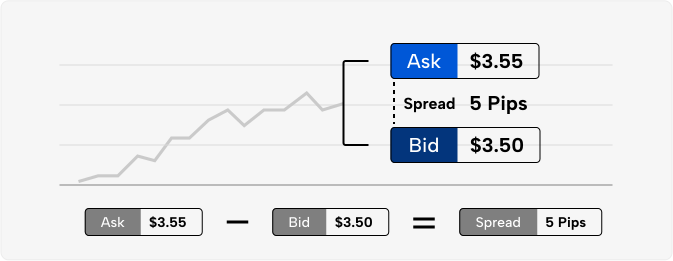
In trading, the bid price and ask price represent the best prices that buyers and sellers are willing to transact at.
• Bid Price: This is the highest price a buyer is ready to pay for a financial instrument.
• Ask Price: This is the lowest price a seller is willing to accept.
The difference between these two prices is known as the bid-ask spread.
Fees and charges
Mitrade does not charge any fees beyond the buy-sell spreads and overnight fees. Our primary compensation comes from the market spread.
For instance, when trading GBP/JPY, if the buy rate is 160.250, the sell rate would be 160.200. This results in a market spread of 5 pips.
Overnight Fees
When trading Contracts for Difference (CFDs), you utilize leverage, which allows you to control a larger position than your initial deposit. However, if you wish to keep your position open beyond the daily cut-off time, you’ll incur an overnight fee.
This fee reflects the cost of financing your position overnight and includes a small administrative charge. Here are the key points to remember:
• The daily cut-off time is at 10 PM UK time , although this may vary for international markets.
• If you hold a position past this cut-off, a daily interest fee will be applied to your account.