


Japanese Yen round-trips Tokyo's record intervention just in time for CPI
- The Yen is back at its weakest levels since the late April slide that forced Tokyo's hand.
- Markets price an imminent BoJ rate hike and the Yen still cannot find a bid.
- Wednesday's US CPI is expected to show headline inflation accelerating sharply.
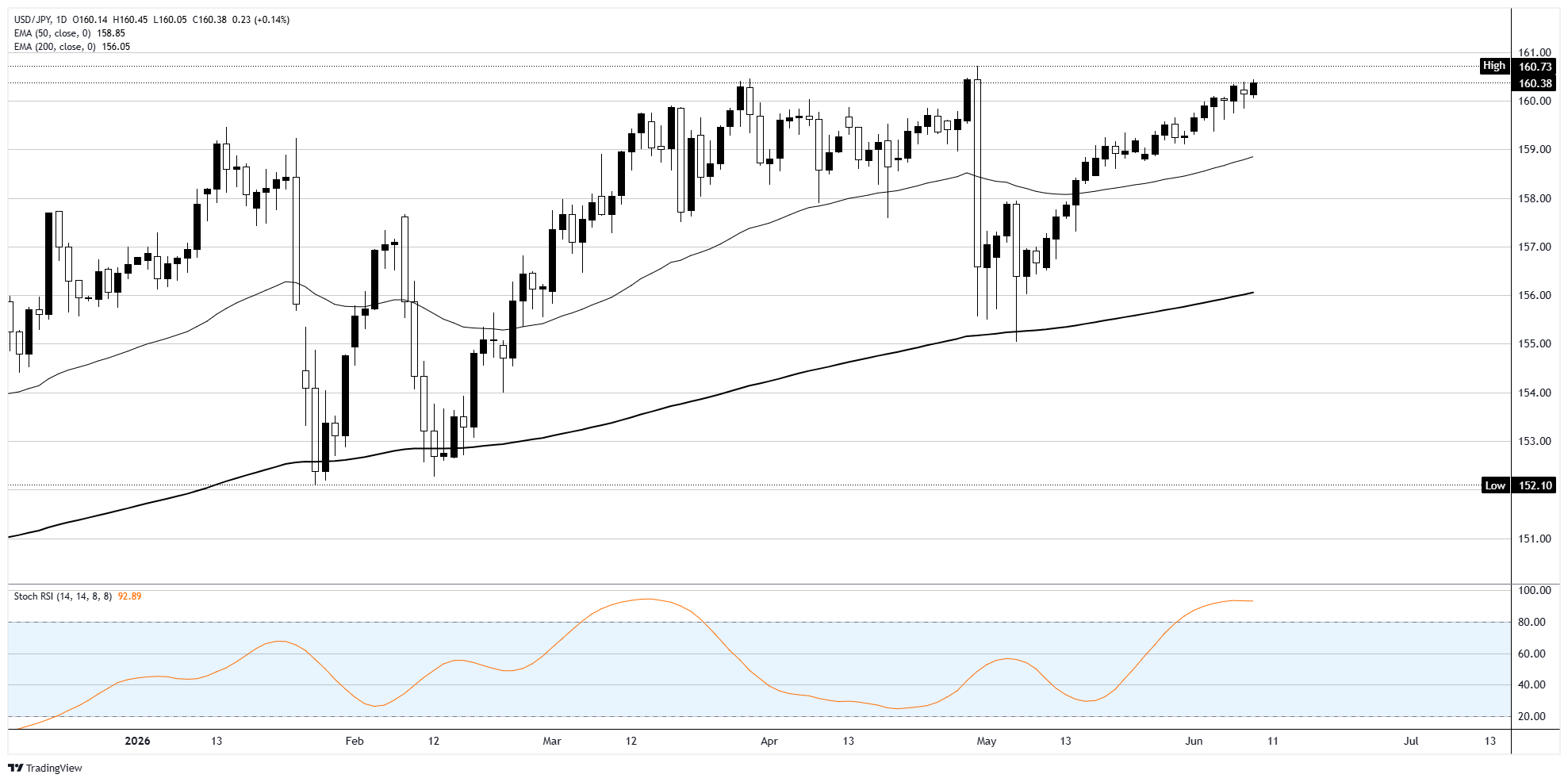
Six weeks ago Japan reportedly spent a record sum dragging this pair off exactly this shelf. On Tuesday, USD/JPY ground from an early low near 160.00 to a session high just shy of 160.50, its strongest level since the late April spike that triggered intervention, before settling just beneath the high into the close. The entire operation has now been round-tripped, politely, a handful of pips at a time, and the Ministry of Finance (MoF) has so far responded with vocabulary rather than Dollars.
The intervention premium is gone
The late April yen-buying operation, reportedly the largest on record, plus a suspected follow-up in early May, bought roughly five big figures of relief. All of it has been handed back. When the pair first re-tagged the trigger zone early last week, both the Prime Minister and the finance minister warned about speculative, one-sided moves, and the resulting bounce lasted a few hours. The market has concluded that jawboning is free and is pricing it accordingly. It does not help that the Middle East war keeps Crude Oil elevated, meaning Japan's own energy import bill does a chunk of the Yen selling without any speculator's assistance.
Even an imminent hike cannot buy a bid
The genuinely strange part is that markets assign roughly an 80% probability of the Bank of Japan (BoJ) hiking its policy rate to 1.00% at the June 15 to 16 meeting, the highest setting in three decades, and the governor has all but pre-announced it. Sunday's final Q1 Gross Domestic Product (GDP) was revised up to 0.5% QoQ against 0.3% expected, with the annualized rate at 1.8%. Decent growth, sticky domestic inflation, a hike days away, and the currency still cannot rally. The math explains the apathy: the Federal Reserve (Fed) sits at 3.50% to 3.75%, cuts have been priced out of CME FedWatch for the year, and odds of a hike later in 2026 keep climbing after last week's Nonfarm Payrolls (NFP) beat. Twenty-five basis points from the BoJ barely dents that gap, and carry traders know it.
The chart only knows one direction
The daily picture is about as one-way as charts get, with price sitting comfortably above the 50-day Exponential Moving Average (EMA) near 159.00 and the 200-day EMA around 156.00, while the daily Stochastic Relative Strength Index (Stoch RSI) has been parked in the 90s. Overbought has been a condition here, not a signal. The only resistance left on the chart is the late April peak just above 160.50, and the only thing standing in front of it is the MoF.
Wednesday decides whether Tokyo gets dragged back in
US Consumer Price Index (CPI) data for May lands Wednesday at 12:30 GMT. Consensus looks for 0.5% MoM, with the YoY rate accelerating to 4.2% from 3.8%, which would be the fastest pace in roughly three years, while core is seen at 0.3% MoM and 2.9% YoY. The jump is mostly energy passthrough from the war premium, which the Fed claims to look through, but a hot print would still harden the higher-for-longer story and shove the pair into territory where intervention stops being a threat and becomes a scheduling question. A soft core reading offers the Yen a reprieve, though every dip this quarter has been bought.
The framework
Upside: a sustained break above 160.50 targets the late April peak, with the 161.00 handle behind it. That is also where headline risk from Tokyo peaks, so chasing strength up there amounts to donating to the MoF.
Downside: initial support near 160.00, then 159.50, with the 50-day EMA close to 159.00 defining the broader uptrend.
Bias: higher on a hot CPI, but with tight risk. This is a market grinding into two central bank meetings and a finance ministry with a famously large checkbook.
USD/JPY daily chart
Japanese Yen FAQs
The Japanese Yen (JPY) is one of the world’s most traded currencies. Its value is broadly determined by the performance of the Japanese economy, but more specifically by the Bank of Japan’s policy, the differential between Japanese and US bond yields, or risk sentiment among traders, among other factors.
One of the Bank of Japan’s mandates is currency control, so its moves are key for the Yen. The BoJ has directly intervened in currency markets sometimes, generally to lower the value of the Yen, although it refrains from doing it often due to political concerns of its main trading partners. The BoJ ultra-loose monetary policy between 2013 and 2024 caused the Yen to depreciate against its main currency peers due to an increasing policy divergence between the Bank of Japan and other main central banks. More recently, the gradually unwinding of this ultra-loose policy has given some support to the Yen.
Over the last decade, the BoJ’s stance of sticking to ultra-loose monetary policy has led to a widening policy divergence with other central banks, particularly with the US Federal Reserve. This supported a widening of the differential between the 10-year US and Japanese bonds, which favored the US Dollar against the Japanese Yen. The BoJ decision in 2024 to gradually abandon the ultra-loose policy, coupled with interest-rate cuts in other major central banks, is narrowing this differential.
The Japanese Yen is often seen as a safe-haven investment. This means that in times of market stress, investors are more likely to put their money in the Japanese currency due to its supposed reliability and stability. Turbulent times are likely to strengthen the Yen’s value against other currencies seen as more risky to invest in.
Artigos Recomendados


