

USD/INR rises further as foreign outflow from India advances
- The Indian Rupee falls further to near 90.00 against the US Dollar amid strong Greenback’s demand by Indian importers.
- FIIs turned out to be net sellers on the first trading day of December.
- Weak US ISM Manufacturing PMI strengthens the case for another Fed interest rate cut this year.
The Indian Rupee (INR) opens on a weak note against the US Dollar (USD) on Tuesday. The USD/INR pair rises to near 90.00 as the Indian Rupee continues to underperform its peers amid strong US Dollar demand by importers and the consistent outflow of foreign funds from the Indian stock market.
Foreign Institutional Investors (FIIs) are consistently paring their stake in the Indian stock market amid uncertainty surrounding the trade deal between India and the United States (US). In the last five months, starting July, FIIs have dumped their stake worth Rs. 1,49,718.16 crore. Additionally, overseas investors turned out to be net sellers on the first trading day of December, dumping shares worth Rs. 1,171.31 crores.
The Indian Rupee has failed to attract bids even as domestic Q3 Gross Domestic Product (GDP) data has come in stronger-than-projected. India’s Ministry of Statistics reported on Friday that the economy expanded at a robust pace of 8.2% on an annualized basis, faster than expectations of 7.3% and the prior reading of 7.8%. This was the fastest growth seen in over six quarters.
Going forward, the major trigger for the Indian Rupee will be the monetary policy announcement by the Reserve Bank of India (RBI) on Friday. Market experts are mixed over whether the RBI will cut interest rates in the last policy meeting of the year amid strong GDP growth and inflation remaining well below the central bank’s tolerance range of 2%-6%.
Investors await US ADP Employment Change and ISM Services PMI
- The Indian Rupee struggles to gain ground against the US Dollar, even as the latter struggles to extend Monday’s recovery move. On Monday, the US Dollar Index (DXY), which tracks the Greenback’s value against six major currencies, attracted significant bids after revisiting the monthly low near 99.00. During the press time, the USD Index trades almost flat around 99.40.
- The US Dollar rebounded even as the US Manufacturing Purchasing Managers’ Index (PMI) data for November came in weaker than projected. The Manufacturing PMI dropped to 48.2, while it was expected to come in marginally lower at 48.6 from 48.7 in October. The sub-components of the Manufacturing PMI, such as Employment and New Orders Index, also came significantly lower, which prompted fears of an overall weak demand environment.
- Analysts at ANZ stated that weakness in gauges of employment and new orders in the manufacturing sector supports the case of further monetary policy expansion by the Federal Reserve (Fed) going forward. "It all suggests that demand in the economy has decelerated, adding that the Fed needs to cut interest rates, and not just in December, but follow through with further cuts next year," ANZ said.
- According to the CME FedWatch tool, there is an 87.2% chance that the Fed will cut interest rates by 25 basis points (bps) to 3.50%-3.75% in the December policy meeting.
- For more cues on the Fed’s monetary policy outlook, investors will focus on the US ADP Employment Change and the ISM Services PMI data for November, which will be released on Wednesday. The ADP Employment Change data is expected to show that private employers added 10K fresh workers, significantly lower than 42K in October. The ISM Services PMI is seen lower at 52.1 from 52.4 in October.
Technical Analysis: USD/INR stays firm near all-time high around 90.00
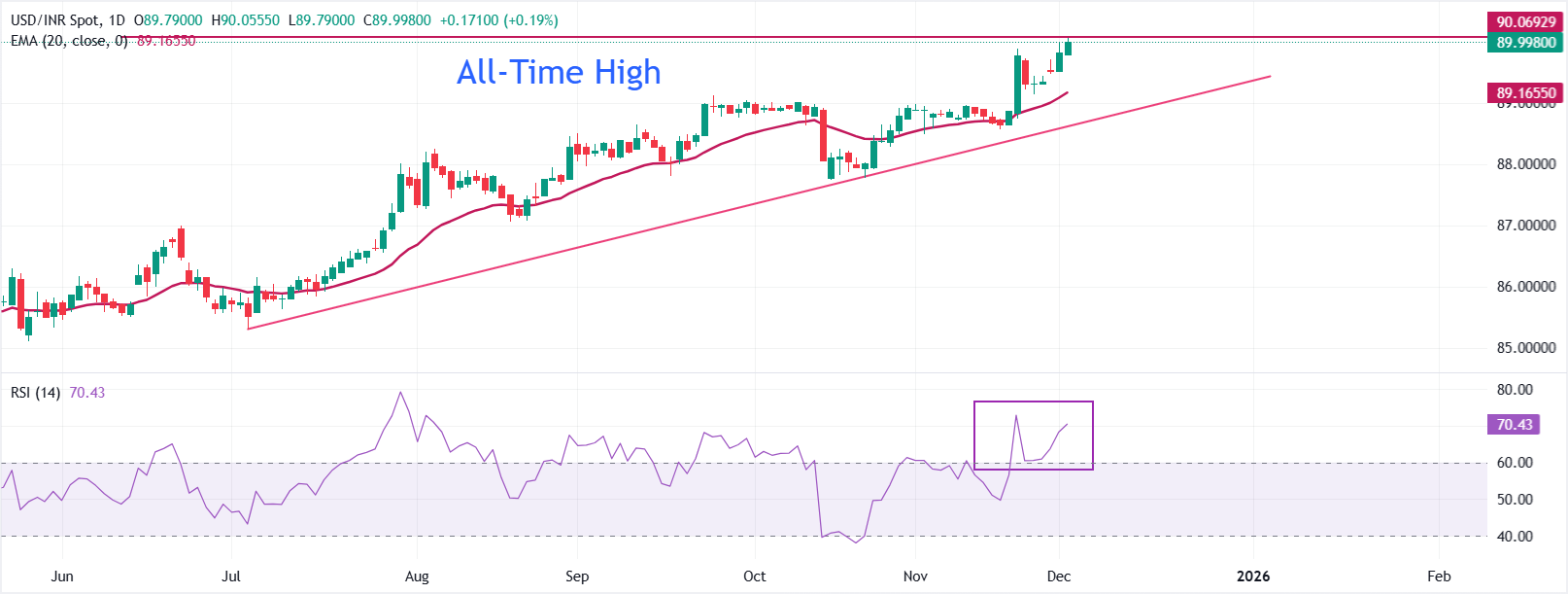
In the daily chart, USD/INR trades at 89.99 in the opening session on Tuesday. The pair holds well above the rising 20-day Exponential Moving Average (EMA) at 89.1655, and the steeper slope confirms a strengthening short-term uptrend. Dips would find initial support at that average.
The 14-day Relative Strength Index (RSI) at 70.43 is overbought. Therefore, the odds are high that the upside could pause if momentum cools.
The rising trend line from 85.3040 underpins the bullish bias, with support flagged near 88.6815. Holding above that line and the 20-day EMA keeps the upside intact. A daily close beneath the 20-day EMA could expose the pair toward the rising trend line around 89.00.
(The technical analysis of this story was written with the help of an AI tool)
Indian Rupee FAQs
The Indian Rupee (INR) is one of the most sensitive currencies to external factors. The price of Crude Oil (the country is highly dependent on imported Oil), the value of the US Dollar – most trade is conducted in USD – and the level of foreign investment, are all influential. Direct intervention by the Reserve Bank of India (RBI) in FX markets to keep the exchange rate stable, as well as the level of interest rates set by the RBI, are further major influencing factors on the Rupee.
The Reserve Bank of India (RBI) actively intervenes in forex markets to maintain a stable exchange rate, to help facilitate trade. In addition, the RBI tries to maintain the inflation rate at its 4% target by adjusting interest rates. Higher interest rates usually strengthen the Rupee. This is due to the role of the ‘carry trade’ in which investors borrow in countries with lower interest rates so as to place their money in countries’ offering relatively higher interest rates and profit from the difference.
Macroeconomic factors that influence the value of the Rupee include inflation, interest rates, the economic growth rate (GDP), the balance of trade, and inflows from foreign investment. A higher growth rate can lead to more overseas investment, pushing up demand for the Rupee. A less negative balance of trade will eventually lead to a stronger Rupee. Higher interest rates, especially real rates (interest rates less inflation) are also positive for the Rupee. A risk-on environment can lead to greater inflows of Foreign Direct and Indirect Investment (FDI and FII), which also benefit the Rupee.
Higher inflation, particularly, if it is comparatively higher than India’s peers, is generally negative for the currency as it reflects devaluation through oversupply. Inflation also increases the cost of exports, leading to more Rupees being sold to purchase foreign imports, which is Rupee-negative. At the same time, higher inflation usually leads to the Reserve Bank of India (RBI) raising interest rates and this can be positive for the Rupee, due to increased demand from international investors. The opposite effect is true of lower inflation.
Artigos Recomendados


