


Prediction: SpaceX, Anthropic, and OpenAI Will Push the S&P 500 Dividend Yield to an All-Time Low. Here's What Income Investors Can Do About It.
Key Points
Many of today’s leading companies have no or low dividends, driving down the yield of the S&P 500.
SpaceX, Anthropic, and OpenAI will likely be added to the S&P 500 in 2027, dragging the index’s yield lower.
Growth companies tend reinvest in their underlying businesses rather than return capital to shareholders.
- 10 stocks we like better than S&P 500 Index ›
SpaceX is planning its initial public offering (IPO) for June 12, raising $75 billion at a valuation of $1.77 trillion. Anthropic filed its Form S-1 with the Securities and Exchange Commission on June 1, which could mean it could go public as early as July. OpenAI may go public as soon as September.
Here's why these three blockbuster IPOs could push the S&P 500 (SNPINDEX: ^GSPC) dividend yield below 1%, and what investors can do about it.
Will AI create the world's first trillionaire? Our team just released a report on the one little-known company, called an "Indispensable Monopoly" providing the critical technology Nvidia and Intel both need. Continue »

Image source: Getty Images.
Justifying the S&P 500's low yield
S&P Dow Jones indices was considering fast-tracking the inclusion of megacap companies into the S&P 500 well before its typical 12-month seasoning period. But on June 4, the index provider published a press release stating that newly public companies, regardless of size, must wait at least 12 months before being included. That means we won't see SpaceX, Anthropic, and OpenAI in the S&P 500 until 2027.
However, once they are added, they could push the S&P 500 dividend yield even lower. The S&P 500 dividend yield currently sits at 1.1% -- which is the lowest since the 1800s. The yield has fallen because the S&P 500 no longer looks like it used to in the past.
When the index was formed, many of America's most valuable companies were involved in heavy industries such as steel, rail, manufacturing, infrastructure, farming, and oil and gas. Today, technology makes up a staggering 38.6% of the S&P 500. The tech sector, plus Alphabet, Meta Platforms, Amazon, and Tesla -- which aren't in the tech sector but are tech-focused companies -- is 53.6% of the index.
Dividends were once the core reason for investing in stocks, especially before the rise of electronic exchanges and trading. In the Autobiography of Andrew Carnegie, the steel and railroad magnate discusses that his excitement for receiving his first dividend check in the mail in his early 20s exceeded the thrill of later making a fortune. But today, the vast majority of S&P 500 gains are driven by capital gains rather than dividends.
Warren Buffett once said: "The ideal business is one that earns very high returns on capital and keeps using lots of capital at those high returns. That [business] becomes a compounding machine." The catch is that as businesses grow, it becomes increasingly difficult to maintain a high return on capital. There's only so much Coca-Cola the world will consume. But tech companies aren't limited by the constraints of the physical world.
Even at massive sizes, many of today's top companies continue to generate an incredibly effective return on capital employed (ROCE). Buffett would say that 20% or more is an excellent ROCE, meaning a company generates $0.20 of operating profit for every dollar of capital invested in the business. With the exception of Amazon and Tesla, which are incredibly capital-intensive companies, today's leading growth stocks are all well over that level.
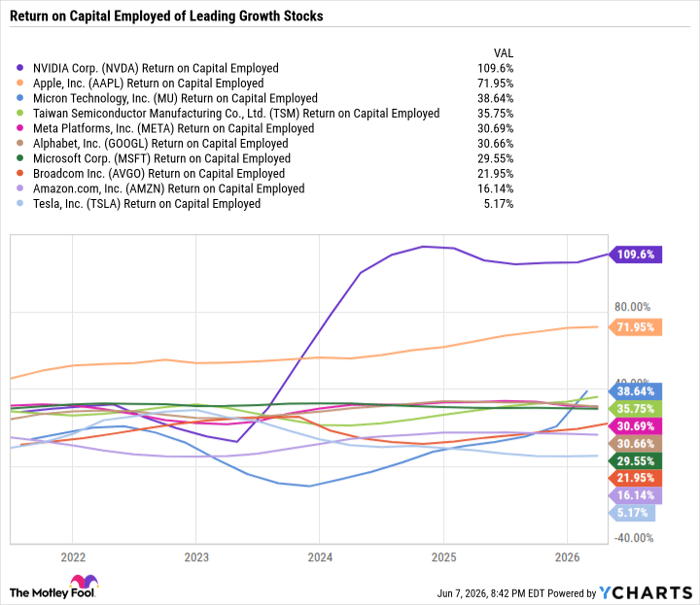
NVDA Return on Capital Employed data by YCharts
When companies are earning that much profit from the capital they use, it makes far more sense to invest that capital in growing the business rather than return it to shareholders through dividends. That's why many top tech giants spend more on buybacks than dividends. Buying back stock in a great business that continues to grow in value is a better use of capital than dividends.
The S&P 500 dividend yield has fallen sharply over the years because stock prices have risen faster than dividend growth rates. But the bigger story is that today's leading companies are far higher-quality than market leaders from even a couple of decades ago because they can generate high returns on capital employed even at their behemoth sizes. So it's in shareholders' best interest to keep reinvesting capital as long as there are worthwhile markets to explore.
SpaceX, Anthropic, and OpenAI operate in industries that didn't even exist a few decades ago. Given that they are in the capital-raising stage, it's highly unlikely any of these companies will pay dividends for the foreseeable future. If all three were magically added to the S&P 500 at their most recent quoted valuations -- $1.77 trillion for SpaceX, $965 billion for Anthropic, and $852 billion for OpenAI -- they would have a combined value of $3.59 trillion. That's more than Microsoft, which makes up 4.6% of the S&P 500.
S&P 500 index fund alternatives
Adding more hypergrowth stocks to the S&P 500 should push its yield below 1% in the second half of 2027. Investors who only care about total return may not mind the lower yield. But investors who use passive income from their stock investments as a core part of their financial strategy, like supplementing income in retirement, may want to consider exchange-traded funds (ETFs) that won't be buying SpaceX, Anthropic, or OpenAI.
The Vanguard Dividend Appreciation ETF (NYSEMKT: VIG) includes a blend of industry-leading companies across all stock market sectors with track records of consistently raising dividends. With Broadcom, Apple, and Microsoft as its top three holdings, the ETF is chock-full of growth potential and offers a 1.5% dividend yield, making it an excellent choice for investors who want a bit of passive income from a low-cost fund.
Another compelling choice is the Vanguard Value ETF (NYSEMKT: VTV), which offers an even higher 1.9% yield by severely underweighting tech stocks relative to the S&P 500.
Should you buy stock in S&P 500 Index right now?
Before you buy stock in S&P 500 Index, consider this:
The Motley Fool Stock Advisor analyst team just identified what they believe are the 10 best stocks for investors to buy now… and S&P 500 Index wasn’t one of them. The 10 stocks that made the cut could produce monster returns in the coming years.
Consider when Netflix made this list on December 17, 2004... if you invested $1,000 at the time of our recommendation, you’d have $445,672!* Or when Nvidia made this list on April 15, 2005... if you invested $1,000 at the time of our recommendation, you’d have $1,280,566!*
Now, it’s worth noting Stock Advisor’s total average return is 948% — a market-crushing outperformance compared to 206% for the S&P 500. Don't miss the latest top 10 list, available with Stock Advisor, and join an investing community built by individual investors for individual investors.
See the 10 stocks »
*Stock Advisor returns as of June 9, 2026.
Daniel Foelber has positions in Nvidia. The Motley Fool has positions in and recommends Alphabet, Amazon, Apple, Broadcom, Micron Technology, Microsoft, Nvidia, Taiwan Semiconductor Manufacturing, Tesla, Vanguard Dividend Appreciation ETF, and Vanguard Value ETF. The Motley Fool has a disclosure policy.
Recommended Articles


