


SpaceX vs. Rocket Lab: How Do They Compare as Investments?
Key Points
SpaceX targets an IPO valuation of $1.77 trillion, while Rocket Lab trades at a market cap of $66 billion.
SpaceX has evolved, thriving on Starlink's $4.4 billion in operating income, while Rocket Lab awaits Neutron's debut.
Neither company is profitable, and both face significant execution risks. Both carry similarly stretched price-to-sales multiples.
- 10 stocks we like better than Rocket Lab ›
After shares of SpaceX hit the market later this month, investors will finally be able to invest directly in the company that made reusable rockets mainstream and now runs the world's largest satellite internet network.
But for years now, retail traders have turned to Rocket Lab (NASDAQ: RKLB) as the closest publicly available proxy. So, now that they will both be available, which is the better investment? The scrappy challenger? Or the space behemoth?
Will AI create the world's first trillionaire? Our team just released a report on the one little-known company, called an "Indispensable Monopoly" providing the critical technology Nvidia and Intel both need. Continue »
Neither company is profitable yet
SpaceX and Rocket Lab have a lot in common: Both are vertically integrated aerospace businesses chasing the same growing market. That being said, they differ in some important ways, including operating at very different scales.
SpaceX, founded in 2002 by Elon Musk, generated $18.7 billion in revenue in 2025 across three segments -- Starlink, launch, and AI. The company is targeting a valuation of $1.77 trillion at its IPO on June 12.
Rocket Lab, founded in 2006 by Peter Beck, brought in $602 million in 2025 -- about 3% of SpaceX's revenue -- split between launch and spacecraft components.
Here's a table comparing the basics.
| SpaceX (SPCX) | Rocket Lab (RKLB) | |
|---|---|---|
| Status | IPO in June | Public |
| 2025 revenue | $18.7 billion | $602 million |
| Revenue growth (2025) | 33% | 38% |
| Profitable? | No | No |
| Market cap | ~$1.77 trillion (IPO target) | ~$66 billion |
Data source: Company filings, CNBC.
Despite their massive size differences, both companies carry similarly stretched valuations -- and neither turns a GAAP profit.
Two different bets on space
Besides scale, the companies differ in a couple of key ways.
Fundamentally, SpaceX isn't really a pure-play space company anymore. It's morphed into a sort of conglomerate of futuristic technologies. Its S-1 claims a $28.5 trillion total addressable market, but 93% of that figure comes from AI and other technologies and businesses that SpaceX currently does not have or operate in.
And Starlink, its satellite internet service, is the real profit engine. This unit generated $4.4 billion in operating income in 2025. The business most people associate with SpaceX, Launch, is secondary at this point -- at least financially.
In contrast, Rocket Lab is a purer space play.
The company's Electron rocket has made it the second-most-used launch provider in the U.S., and its spacecraft components business has grown to account for 68% of revenue.
Neutron, its medium-lift reusable rocket, is set for a debut later this year. A successful Neutron launch would put Rocket Lab in more direct competition with SpaceX's core launch business for the first time. It would open the door to the launch market that its rival currently dominates with the Falcon 9.
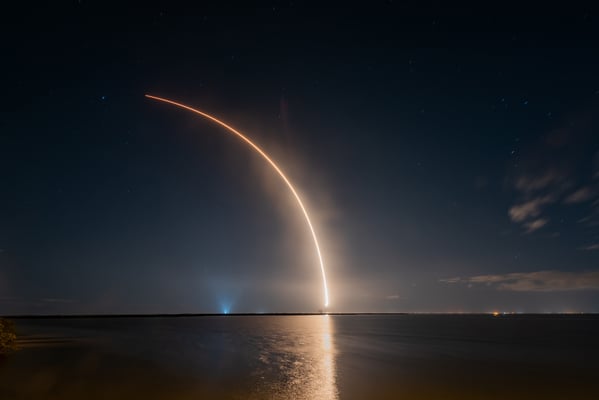
Image source: Getty Images.
The risks are as large as the opportunities
Neither company has proven it can generate sustainable profits at scale, and both carry significant execution risk.
For Rocket Lab, the central question is Neutron. The rocket has already experienced cost overruns and multiple delays, including a setback from a tank failure earlier this year, which pushed the first flight to Q4 at the earliest.
Until Neutron flies and scales successfully, Rocket Lab's path to profitability remains murky: Free cash flow (FCF) was negative $321.8 million in 2025. That's expected to widen, at least in the medium term, as its Neutron program gets built out.
SpaceX's biggest risk is AI. The segment lost $6.4 billion in 2025 and was burning roughly $2.5 billion per quarter as of Q1 2026. At this point, there's no real path to durable profitability here.
And of course, investors need to know that Musk controls 85.1% of voting power through super-voting shares. That leaves you with virtually no recourse if the company's strategy goes sideways.
Valuation: Expensive across the board
At SpaceX's $1.77 trillion IPO target, both companies trade at comparable price-to-sales multiples -- somewhere in the 100x range. They are extreme, to say the least.
But despite their similarity, SpaceX's is actually more so. Or at least Rocket Lab's is easier to defend. SpaceX's own success proves Rocket Lab's market cap has room to grow. There's a proven path for it to grow into its nearly $70 billion valuation.
It's a whole different story to grow a $1.77 trillion company in this market. There's no precedent for what SpaceX is doing, really.
Should you buy stock in Rocket Lab right now?
Before you buy stock in Rocket Lab, consider this:
The Motley Fool Stock Advisor analyst team just identified what they believe are the 10 best stocks for investors to buy now… and Rocket Lab wasn’t one of them. The 10 stocks that made the cut could produce monster returns in the coming years.
Consider when Netflix made this list on December 17, 2004... if you invested $1,000 at the time of our recommendation, you’d have $445,672!* Or when Nvidia made this list on April 15, 2005... if you invested $1,000 at the time of our recommendation, you’d have $1,280,566!*
Now, it’s worth noting Stock Advisor’s total average return is 948% — a market-crushing outperformance compared to 206% for the S&P 500. Don't miss the latest top 10 list, available with Stock Advisor, and join an investing community built by individual investors for individual investors.
See the 10 stocks »
*Stock Advisor returns as of June 9, 2026.
Johnny Rice has no position in any of the stocks mentioned. The Motley Fool has positions in and recommends Rocket Lab. The Motley Fool has a disclosure policy.
Recommended Articles


