


Prediction: Fed Chair Kevin Warsh and the FOMC Will Draw President Donald Trump's Ire by Making a Necessary Policy Adjustment Next Week
Key Points
Jerome Powell's term as Fed chair ended on May 15, paving the way for Trump's handpicked successor to officially become head of the central bank on May 22.
Although the president has repeatedly called for interest rate cuts, surging inflation from the Iran war has other plans.
The first big move Kevin Warsh oversees as Fed chair will be to shelve the FOMC's easing bias statement.
- 10 stocks we like better than S&P 500 Index ›
It's been an eventful past couple of weeks on Wall Street. The artificial intelligence revolution has lifted the Dow Jones Industrial Average (DJINDICES: ^DJI), S&P 500 (SNPINDEX: ^GSPC), and Nasdaq Composite (NASDAQINDEX: ^IXIC) to new highs, and Wall Street's preeminent financial institution, the Federal Reserve, has a new boss.
Jerome Powell's tenure as Fed chair ended on May 15, paving the way for President Donald Trump's handpicked successor, Kevin Warsh, to take the helm (officially) on May 22.
Will AI create the world's first trillionaire? Our team just released a report on the one little-known company, called an "Indispensable Monopoly" providing the critical technology Nvidia and Intel both need. Continue »
But while Trump noted at Warsh's White House swearing-in ceremony that he wants "Kevin to be totally independent," this independence could quickly draw the ire of a president who's eager to see interest rates cut, as well as upset a historically pricey stock market.

Fed Chair Kevin Warsh delivering remarks at his swearing-in ceremony. Official White House Photo by Daniel Torok.
Donald Trump has repeatedly called on the FOMC to slash interest rates
For more than a year leading up to Powell's departure, Trump was publicly chastising Powell and other Federal Open Market Committee (FOMC) members for not cutting interest rates. The FOMC is the 12-person entity, including the Fed chair, responsible for setting the nation's monetary policy.
Although the FOMC lowered the federal funds target rate six times from September 2024 to December 2025, it's nowhere close to the president's desired level of 1% or lower.
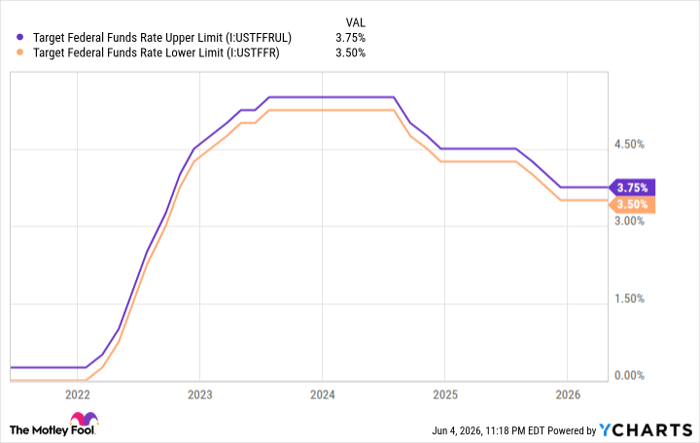
Target Federal Funds Rate Upper Limit data by YCharts.
President Trump likely has several reasons to push for lower interest rates. For one, it would make it considerably easier to service the nation's more than $39 trillion in national debt. Lower borrowing costs would also be expected to reduce mortgage rates (making housing more affordable) and encourage businesses to boost hiring and spending on innovation.
However, a historic surge in inflation caused by the Iran war is likely to lead Trump's calls for lower rates to fall on deaf ears.

Image source: Getty Images.
Warsh and the FOMC will likely shelve the easing bias statement next week
Since the start of the Iran war on Feb. 28, the Strait of Hormuz has been effectively closed to commercial traffic. This has stymied the movement of 20 million barrels of petroleum liquids per day and sent energy prices soaring. Drivers have certainly felt the pinch at the pump.
The concern is that energy price shocks typically spill over to non-energy industries. While the effects of inflation are often delayed by a few months for businesses, higher transportation and/or production costs can further lift prices.
In February, trailing 12-month (TTM) inflation clocked in at just 2.4%. According to the Cleveland Fed's latest forecast for May, TTM inflation is projected to rise to 4.18%.
FED HIKE ODDS JUMP
-- *Walter Bloomberg (@DeItaone) May 22, 2026
Markets now price a 43% chance of a Fed hike before 2027 -- the highest in months.
Odds have climbed in 2026 as the Fed stays on hold.https://t.co/sO21R9Zvxv
Next FOMC: June 30 (39 days). pic.twitter.com/ef91xFCZ2w
While a historically hawkish Kevin Warsh and the FOMC are likely to take a wait-and-see approach with interest rates, the same can't be said for the Fed's easing bias statement. Although three FOMC members officially opposed the easing bias statement at Powell's last meeting as Fed chair on April 29, the Fed meeting minutes showed that a majority of FOMC members favored shelving the easing bias.
More than likely, we're going to see the FOMC shift to a neutral bias at the June 17 meeting, confirming to Wall Street and President Trump that rate cuts aren't on the horizon. This could be a tough pill for an expensive stock market to swallow, and it'll likely draw unwanted attention to the central bank from Donald Trump.
Should you buy stock in S&P 500 Index right now?
Before you buy stock in S&P 500 Index, consider this:
The Motley Fool Stock Advisor analyst team just identified what they believe are the 10 best stocks for investors to buy now… and S&P 500 Index wasn’t one of them. The 10 stocks that made the cut could produce monster returns in the coming years.
Consider when Netflix made this list on December 17, 2004... if you invested $1,000 at the time of our recommendation, you’d have $443,191!* Or when Nvidia made this list on April 15, 2005... if you invested $1,000 at the time of our recommendation, you’d have $1,258,838!*
Now, it’s worth noting Stock Advisor’s total average return is 941% — a market-crushing outperformance compared to 206% for the S&P 500. Don't miss the latest top 10 list, available with Stock Advisor, and join an investing community built by individual investors for individual investors.
See the 10 stocks »
*Stock Advisor returns as of June 9, 2026.
Sean Williams has no position in any of the stocks mentioned. The Motley Fool has no position in any of the stocks mentioned. The Motley Fool has a disclosure policy.
Recommended Articles


