


Nvidia CEO Jensen Huang Just Declared War on Intel, AMD, and Qualcomm -- and the PC Market Will Never Be the Same
Key Points
Huang thinks that Nvidia's new RTX-Spark superchip will reinvent the PC.
Nvidia's entrance into the market has significant repercussions for Intel, AMD, and Qualcomm.
However, Nvidia's new PC chip may not move the needle much for the company over the near term.
- 10 stocks we like better than Nvidia ›
It took a while for the full impact of the personal computer to be appreciated after John Blankenbaker introduced the first PC -- the Kenbak-1 -- in 1971. It might also take a while to digest the ramifications of Nvidia (NASDAQ: NVDA) CEO Jensen Huang's proclamation a few days ago, "The PC is being reinvented."
What we can know now, though, is that Huang declared war on Intel (NASDAQ: INTC), Advanced Micro Devices (NASDAQ: AMD), and Qualcomm (NASDAQ: QCOM). And the PC market will never be the same.
Will AI create the world's first trillionaire? Our team just released a report on the one little-known company, called an "Indispensable Monopoly" providing the critical technology Nvidia and Intel both need. Continue »
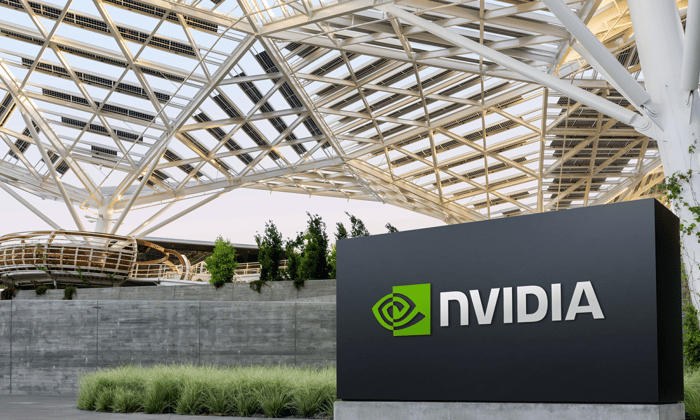
Image source: Nvidia.
A new era for PC technology
Nvidia isn't attempting to reinvent the PC on its own. The company collaborated with Microsoft (NASDAQ: MSFT) to integrate AI agents into Windows. It also worked with Taiwan's MediaTek, a leader in building systems-on-a-chip based on Arm's (NASDAQ: ARM) architecture, on custom CPU design.
Nvidia's RTX Spark was the result of this team effort. It's a new superchip that Nvidia says "reinvents Windows PCs for the era of personal AI agents." RTX Spark includes an Nvidia Blackwell RTX GPU and Nvidia NVLink-C2C to connect to a Nvidia Grace CPU.
How will RTX Spark change PCs? Huang explained it this way: "For forty years, you launched apps. Click. Type. With RTX Spark and Microsoft Windows, you ask -- and the PC does the work." He added, "Local agents. Frontier models. Creative workflows, RTX games. All on a laptop. This is the new PC. The personal AI computer."
Nvida's new superchip has already secured significant industrywide adoption. PC makers, including ASUS (OTC: ASUUY), Dell (NYSE: DELL), HP (NYSE: HPQ), Lenovo (OTC: LNVGY), Microsoft, and MSI, plan to launch laptops and compact desktop PCs featuring RTX Spark this fall. Acer and Gigabyte won't be too far behind.
Letting the chips fall where they may
Huang's announcement introducing RTX-Spark sent shockwaves across the PC industry. Qualcomm was the hardest hit. The microchip stock is down by a double-digit percentage since the RTX-Spark debut.
Nvidia's new superchip particularly threatens Qualcomm because its Snapdragon chips compete in the same market as RTX-Spark. Nvidia's dominance in the AI community could jeopardize Qualcomm's growth plans for the PC market.
However, Intel arguably faces the broadest threat from RTX-Spark. The technology pioneer's x86 architecture has been a mainstay for Windows PCs for decades. Intel now must compete directly against the world's largest company by market cap.
AMD is in a similar position to Intel. Its chips have been Intel's primary rival for years. AMD has invested heavily in promoting its Ryzen AI processors. But Nvidia's new product could drastically change the competitive dynamics.
Is Nvidia's stock now a no-brainer buy?
Does Nvidia's intention to reinvent the PC make its stock a no-brainer buy? Not on its own. Investors probably shouldn't bank on Nvidia winning big enough in the PC market to move the needle much, at least not over the near term.
The main challenge is that Nvidia's data center business is so large that any new market is likely to amount to little more than a blip. In the first quarter of 2026 alone, the company's data center revenue totaled $75.2 billion, roughly 92% of total revenue.
However, Huang has forecast a $200 billion CPU market, some of which includes AI PCs. He also stated during a keynote address at Taiwan's Computex conference, "This reinvention of the computer is as big a deal as the reinvention of the phone into what we now know as the smartphone."
The PC market truly won't be the same with Nvidia now focusing on it. While the RTX-Spark superchip doesn't make Nvidia's stock a no-brainer buy by itself, it adds yet another reason for investors to consider scooping up shares.
Should you buy stock in Nvidia right now?
Before you buy stock in Nvidia, consider this:
The Motley Fool Stock Advisor analyst team just identified what they believe are the 10 best stocks for investors to buy now… and Nvidia wasn’t one of them. The 10 stocks that made the cut could produce monster returns in the coming years.
Consider when Netflix made this list on December 17, 2004... if you invested $1,000 at the time of our recommendation, you’d have $443,191!* Or when Nvidia made this list on April 15, 2005... if you invested $1,000 at the time of our recommendation, you’d have $1,258,838!*
Now, it’s worth noting Stock Advisor’s total average return is 941% — a market-crushing outperformance compared to 206% for the S&P 500. Don't miss the latest top 10 list, available with Stock Advisor, and join an investing community built by individual investors for individual investors.
See the 10 stocks »
*Stock Advisor returns as of June 9, 2026.
Keith Speights has positions in Microsoft. The Motley Fool has positions in and recommends Advanced Micro Devices, HP, Intel, Microsoft, Nvidia, and Qualcomm. The Motley Fool has a disclosure policy.
Recommended Articles


