


Prediction: It's Only a Matter of Time Before President Donald Trump and Fed Chair Kevin Warsh Are Butting Heads -- and Wall Street May Be the Big Loser
Key Points
Jerome Powell's final day as Fed chair was May 15, with Trump nominee Kevin Warsh becoming the 17th head of the Fed.
Public disagreements over interest rates between President Trump and Powell were commonplace over the last year.
Warsh's historically hawkish FOMC voting record, his criticism of the central bank's bloated balance sheet, and the Iran war's inflationary impact all point to Warsh and Trump publicly feuding over interest rates.
- 10 stocks we like better than S&P 500 Index ›
This has been a history-filled year. We've watched the Dow Jones Industrial Average (DJINDICES: ^DJI), S&P 500 (SNPINDEX: ^GSPC), and Nasdaq Composite (NASDAQINDEX: ^IXIC) rally to all-time highs, and just witnessed only the 17th changing of the guard at America's foremost financial institution, the Federal Reserve.
May 15 marked the final day of Jerome Powell's second term as Fed chair and cleared the way for President Donald Trump's nominee, Kevin Warsh, to become only the 17th head of the Fed since the central bank's creation in 1913.
Will AI create the world's first trillionaire? Our team just released a report on the one little-known company, called an "Indispensable Monopoly" providing the critical technology Nvidia and Intel both need. Continue »
As Trump's hand-picked successor to Powell, there's an expectation that the president and Warsh won't be publicly feuding in the same manner that we witnessed since early 2025 between Powell and Trump. But economic dynamics and the new Fed chair's monetary policy ideology look to have Warsh and Trump on a similar collision course, with Wall Street potentially taking the brunt of the punishment.

President Trump and now-former Fed Chair Powell had publicly feuded over interest rates over the last year. Image source: Official White House Photo by Daniel Torok.
Trump and Powell throwing each other under the bus was commonplace
Although President Trump nominated Jerome Powell during his first, non-consecutive term, disagreements between the two have frequently made headlines since Trump's second term began on Jan. 20, 2025.
The president has openly chastised Powell and other members of the Federal Open Market Committee (FOMC) for not being more aggressive in cutting interest rates. The FOMC -- the 12-person body, including the Fed chair, responsible for setting the nation's monetary policy -- reduced the federal funds target rate six times between September 2024 and December 2025.
Donald Trump has publicly called for interest rates to be slashed to 1% or lower. For context, the federal funds target rate currently sits between 3.5% and 3.75%.
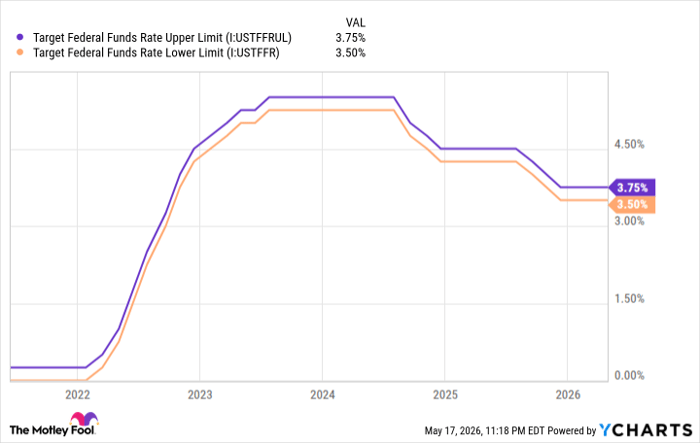
Target Federal Funds Rate Upper Limit data by YCharts.
Lower lending rates would likely increase hiring and spur corporate innovation. Perhaps more importantly, it would make it easier for the U.S. to service its $39 trillion in national debt.
Meanwhile, the sunset of Powell's tenure as Fed chair was marked by two consistencies. First, he regularly rebuffed Trump's calls for dramatically lower interest rates, noting that economic data, not political persuasion, would guide monetary policy decisions.
Secondly, Powell frequently pointed the proverbial finger back at President Trump for the elevated inflation that caused the FOMC to pause its rate-easing cycle. In his prepared statements following FOMC meetings, Powell often cited the stickiness of Trump's tariffs on the goods sector and the energy supply shock tied to the Iran war as reasons inflation was elevated and rate cuts weren't deemed prudent.

Image source: Getty Images.
New Fed chair... likely same result
Although there's optimism that new Fed Chair Kevin Warsh will avoid the public spats that defined Powell's final year as head of the Fed, it's much more likely that we'll see Trump and Warsh butting heads in no time.
Ideologically, Warsh has been labeled a monetary hawk -- and with good reason. During his previous tenure on the FOMC (Feb. 24, 2006 – March 31, 2011), where he helped guide the U.S. economy through the financial crisis, Warsh frequently cautioned against lower interest rates even as the unemployment rate surged. His voting record suggests he favors higher interest rates to suppress inflation.
At the moment, trailing 12-month (TTM) inflation is rapidly rising. Iran's closure of the Strait of Hormuz to virtually all commercial vessels has sent energy prices soaring. Between February and April, TTM inflation has jumped from 2.4% to 3.8% -- and it doesn't look to be done, just yet. The Cleveland Fed's Inflation Nowcasting tool estimates that TTM inflation for May will rise to 4.18%. This would mark its highest level since April 2023.
"If Trump wants someone easy on inflation, he got the wrong guy in Kevin Warsh."@AnnaEconomist pic.twitter.com/FGMfeSqHpU
-- Daily Chartbook (@dailychartbook) January 31, 2026
Kevin Warsh's historically hawkish voting record, coupled with three FOMC members dissenting from the easing bias statement at the April 29 meeting under Powell, strongly suggest an aversion to rate cuts anytime soon.
Additionally, the new Fed chief has been critical of the central bank's expansive balance sheet, composed primarily of U.S. Treasury bonds and mortgage-backed securities. Between August 2008 and March 2022, the Fed's balance sheet grew from less than $900 billion to almost $9 trillion. Despite a multiyear quantitative tightening campaign, the Fed's balance sheet still holds approximately $6.7 trillion in assets.
Warsh wants to meaningfully pare down the central bank's balance sheet and shift its approach to that of a passive observer rather than that of an active market participant. But in doing so, Warsh could pull the rug out from beneath the Trump bull market.
Kevin Warsh Nomination: one reason why market players are interpreting it as a hawkish pick- I agree-is because of his views on the need for a radical balance sheet reduction.
-- Joseph Brusuelas (@joebrusuelas) January 30, 2026
The $31 trillion-dollar American economy demands liquidity & financing needs that are larger than what... pic.twitter.com/zYunGAItV8
Since bond yields and prices are inversely related, selling trillions worth of Treasury bonds would weigh on bond prices, raise yields, and increase borrowing costs. Trump has been chastising Powell and the FOMC for not lowering interest rates, yet Warsh's plan to jettison the Fed's balance sheet assets would have the opposite effect.
Between the Iran war sending inflation notably higher and Warsh's strong monetary policy views, the stage is set for Trump and Warsh to butt heads in the public domain. This is only going to draw attention to worsening inflation forecasts amid a historically expensive stock market.
If we end up trading one feud (Trump vs. Powell) for another (Trump vs. Warsh), it'll likely be the stock market that ends up paying the price.
Should you buy stock in S&P 500 Index right now?
Before you buy stock in S&P 500 Index, consider this:
The Motley Fool Stock Advisor analyst team just identified what they believe are the 10 best stocks for investors to buy now… and S&P 500 Index wasn’t one of them. The 10 stocks that made the cut could produce monster returns in the coming years.
Consider when Netflix made this list on December 17, 2004... if you invested $1,000 at the time of our recommendation, you’d have $477,813!* Or when Nvidia made this list on April 15, 2005... if you invested $1,000 at the time of our recommendation, you’d have $1,320,088!*
Now, it’s worth noting Stock Advisor’s total average return is 986% — a market-crushing outperformance compared to 208% for the S&P 500. Don't miss the latest top 10 list, available with Stock Advisor, and join an investing community built by individual investors for individual investors.
See the 10 stocks »
*Stock Advisor returns as of May 24, 2026.
Sean Williams has no position in any of the stocks mentioned. The Motley Fool has no position in any of the stocks mentioned. The Motley Fool has a disclosure policy.
Recommended Articles


