

Prediction: Bitcoin Will Hit $130,000 in 2026
Key Points
Bitcoin's prior all-time high was more than $126,000.
It has good odds of topping that in 2026.
Inflation and the coin's reputation as a potential inflation hedge are the key drivers.
- 10 stocks we like better than Bitcoin ›
Many investors now treat Bitcoin (CRYPTO: BTC) as a kind of digital cousin to gold, considering its fixed supply and its halving schedule. But with its price little changed this year despite breaching all-time highs on multiple occasions, and with gold's price exploding upward without pause, it's pretty obvious that there are quite a few meaningful differences between those two assets.
Nonetheless, I predict that sometime in 2026, Bitcoin's price will reach or surpass $130,000 as a result of a few factors that might also drive investors to buy more gold. Here's what I think will happen and why.
Where to invest $1,000 right now? Our analyst team just revealed what they believe are the 10 best stocks to buy right now, when you join Stock Advisor. See the stocks »
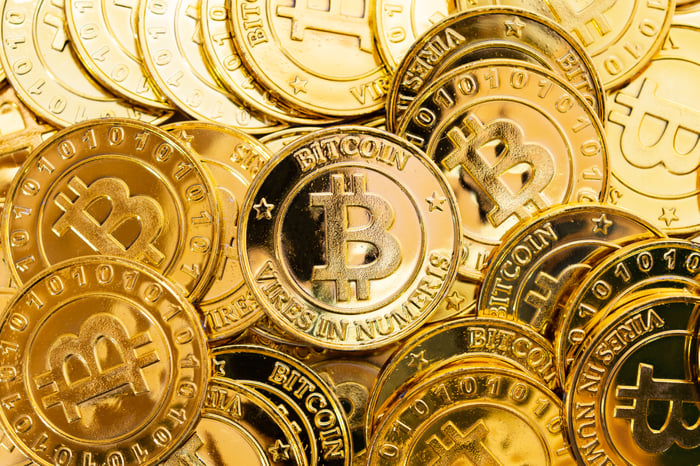
Image source: Getty Images.
The next inflation scare could crown Bitcoin as digital gold
Historically, gold has been the default hedge when investors worry about inflation and issues of fiscal sustainability in government spending. Bitcoin evangelists have insisted that it belongs in that same conversation as a complementary hard money asset. The core argument is that Bitcoin's supply is limited to a maximum of 21 million coins, and its issuance schedule is known in advance, giving it commodity-like scarcity.
Of course, Bitcoin does not have centuries of being used as a store of value like gold does. And that's why many of the risk committees at financial institutions have been cautious about investing heavily in it, as they do not want to declare a new inflation hedge on the basis of one decade of the coin's boom-and-bust cycles. This isn't a proven anti-inflation asset, but it could become one.
Still, if inflation flares up again in 2026 while the headlines about the government's spending plans keep getting worse, it is likely that the pressure to diversify beyond bonds and cash will intensify, particularly within portfolios intended to be inflation-resistant. And that's a big part of why Bitcoin is likely to see an increase of demand next year.
New holders will behave differently than the old set
The biggest narrative change for Bitcoin in the last few years comes from the approval of spot Bitcoin exchange-traded funds (ETFs), which let investors own the asset inside the same brokerage and retirement accounts they already use for stocks and index funds.
In the U.S., spot Bitcoin ETFs now hold more than $120 billion in total assets. These are not fringe financial vehicles anymore; they sit alongside equity and bond ETFs on most investing platforms. The existence of these ETFs increases the odds for the coin to grow significantly on the basis of demand for inflation hedge assets.
Now zoom out. The value of global institutional assets under management (AUM) total somewhere upward of $130 trillion. If only a sliver of that ocean of capital takes Bitcoin seriously as digital gold in the midst of widespread fears about inflation -- and it's very important to note that the public's expectations about future inflation are far more important than the reality here -- the numbers can add up extremely fast.
Assuming that between 0.5% and 1% of global institutional assets eventually finds their way into spot Bitcoin ETFs, that implies potential incremental demand on the order of $650 billion to $1.3 trillion. In comparison, Bitcoin's current market cap is roughly $1.9 trillion. Pushing the total value of all coins into the neighborhood of $2.5 trillion would mean a coin priced at about $130,000.
Is that kind of allocation shift plausible by 2026? It might be, under the conditions of more institutional adoption of Bitcoin and inflation fears that investors choose to mitigate by buying it with meaningful proportions of their wealth.
But before selling the farm and using the proceeds to buy Bitcoin, investors need to be fully cognizant of the fact that its true utility as an inflation hedge has not actually been rigorously established. So, while it's sensible to own some Bitcoin, or even a lot, make sure that your portfolio is still adequately diversified with a lot of other types of investments, as you will need a full roster to both grow and fend off threats from macro problems like inflation.
Should you invest $1,000 in Bitcoin right now?
Before you buy stock in Bitcoin, consider this:
The Motley Fool Stock Advisor analyst team just identified what they believe are the 10 best stocks for investors to buy now… and Bitcoin wasn’t one of them. The 10 stocks that made the cut could produce monster returns in the coming years.
Consider when Netflix made this list on December 17, 2004... if you invested $1,000 at the time of our recommendation, you’d have $540,587!* Or when Nvidia made this list on April 15, 2005... if you invested $1,000 at the time of our recommendation, you’d have $1,118,210!*
Now, it’s worth noting Stock Advisor’s total average return is 991% — a market-crushing outperformance compared to 195% for the S&P 500. Don’t miss out on the latest top 10 list, available when you join Stock Advisor.
See the 10 stocks »
*Stock Advisor returns as of December 1, 2025
Alex Carchidi has positions in Bitcoin. The Motley Fool has positions in and recommends Bitcoin. The Motley Fool has a disclosure policy.
Recommended Articles


