

Should You Buy Constellation Energy While It's Below $400?
Key Points
This power provider operates outside of the regulated utility space.
Constellation Energy has a large fleet of nuclear power plants.
Growing demand for electricity and clean energy bodes well for its future.
- 10 stocks we like better than Constellation Energy ›
Constellation Energy (NASDAQ: CEG) recently rose to roughly $410 per share. That is the stock's all-time and 52-week high. The shares have since pulled back, dropping around 10% or so. Is this the time to act, or should investors hold off on buying this uniquely positioned electricity provider?
There's a big opportunity for Constellation Energy
The major story for Constellation Energy is the significant increase in electricity demand expected to unfold over the next couple of decades. Before explaining that demand, however, it is important to understand the demand history. Between 2000 and 2020, electricity demand increased by just 9%. That's not 9% a year, that's 9% over 20 years. It was a very difficult period for electric utilities.
Where to invest $1,000 right now? Our analyst team just revealed what they believe are the 10 best stocks to buy right now, when you join Stock Advisor. See the stocks »

Image source: Getty Images.
The demand story is expected to be very different between 2020 and 2040. And it has only grown better with time. In 2021, the expectation was that demand would increase by 21% between 2020 and 2040. That's a much better number than the 9% in the previous 20 years. However, the 21% was revised up to 38% in 2024. And it was revised again in 2025, up to a huge 55%. The demand story has gone from good to great, and utilities are set for a capital investment cycle that should boost growth throughout the sector.
Some of the key drivers of the expected demand are artificial intelligence, data centers, and electric vehicles. One of the key beneficiaries of the demand is expected to be clean energy as the world increasingly shifts away from dirtier energy sources, such as coal. A particularly well-positioned power source is nuclear energy, which provides a consistent and reliable power supply (known as baseload power in the industry). Nuclear, which doesn't emit greenhouse gases, can complement intermittent power sources like solar and wind.
This is where Constellation Energy comes in, because it is the largest provider of nuclear power in the United States. That said, the company is not a regulated utility; it is an independent power producer selling electricity on the open market, generally under long-term contracts. This has proven to be a great position, as large companies are increasingly seeking clean energy solutions.
For example, Constellation has inked a deal with Microsoft to supply the technology giant with power from the Three Mile Island site. The contract supports the reopening of the now shuttered nuclear power plant, which was made famous after it narrowly missed a complete reactor meltdown.
It is expensive and time consuming to reopen a power plant, but demand for nuclear power is so high that Microsoft is willing to take the risk on Constellation Energy's ability to get Three Mile Island back up and running (it also plans an update of the name for the site).
The story is good, and Wall Street is excited
There's just one problem for investors: valuation. Constellation Energy has only existed in its current form for a few years, so there are no long-term valuation comparisons available yet. However, investors can compare the stock's valuation to that of the broader utility sector using an exchange-traded fund (ETF), such as Utilities Select Sector SPDR ETF.
Using the ETF as an industry proxy for the utility sector, you'll find that the average utility has a price-to-book value ratio of 2.4 and a price-to-earnings ratio of roughly 20.5. Constellation Energy's P/B ratio is 7.8, and its P/E is just over 41. So Wall Street is placing a valuation on the stock that is roughly twice as high as the average utility.
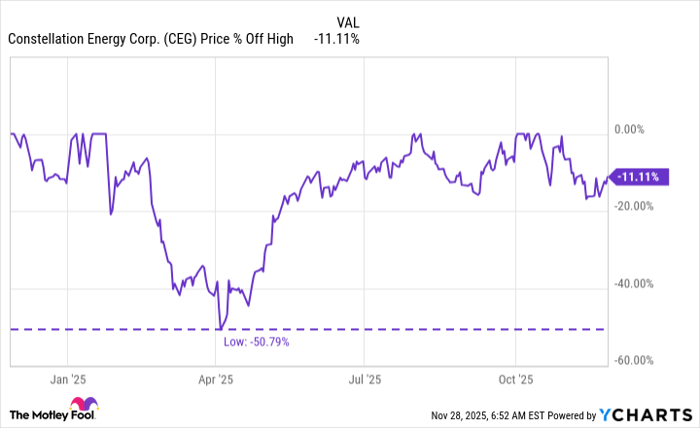
CEG data by YCharts
The lofty premium suggests that investors are, perhaps, a little overexcited about Constellation Energy's prospects. The roughly 10% pullback from the stock's 52-week high has clearly not removed enough of the premium to alter the lofty valuation.
What's more telling, however, is the 50%-plus drop in the stock that occurred earlier in 2025. That hints at the downside risk investors face with Constellation Energy if Wall Street's faith in the future of nuclear power falters.
But the stock isn't worth the risk for most investors
At this point, investors must have a deep conviction in the nuclear power story to justify paying the premium being placed on Constellation Energy's stock. Most investors, particularly those with more conservative investment strategies, should probably stay on the sidelines. A deeper drawdown, such as the one that occurred not too long ago, could alter the narrative.
But, for now, Constellation Energy looks like an expensive way to get your nuclear power exposure.
Should you invest $1,000 in Constellation Energy right now?
Before you buy stock in Constellation Energy, consider this:
The Motley Fool Stock Advisor analyst team just identified what they believe are the 10 best stocks for investors to buy now… and Constellation Energy wasn’t one of them. The 10 stocks that made the cut could produce monster returns in the coming years.
Consider when Netflix made this list on December 17, 2004... if you invested $1,000 at the time of our recommendation, you’d have $588,530!* Or when Nvidia made this list on April 15, 2005... if you invested $1,000 at the time of our recommendation, you’d have $1,102,885!*
Now, it’s worth noting Stock Advisor’s total average return is 1,012% — a market-crushing outperformance compared to 193% for the S&P 500. Don’t miss out on the latest top 10 list, available when you join Stock Advisor.
See the 10 stocks »
*Stock Advisor returns as of December 1, 2025
Reuben Gregg Brewer has no position in any of the stocks mentioned. The Motley Fool has positions in and recommends Constellation Energy and Microsoft. The Motley Fool recommends the following options: long January 2026 $395 calls on Microsoft and short January 2026 $405 calls on Microsoft. The Motley Fool has a disclosure policy.
Recommended Articles


