

Bankless Co-Founder Explains Why He Sold All His Ethereum

Source Newsbtc

Bankless co-founder David Hoffman said he sold his ETH after concluding that the “ETH is money” thesis has largely played out, marking a notable shift from one of Ethereum’s most visible public advocates. Hoffman said he remains “massively bullish” on Ethereum as a network, but no longer sees a clear path for ETH, the asset, to receive a structural rerating from here.

“For someone who built a career, community, identity, and business around Ethereum, this choice does not come lightly,” Hoffman wrote. “The ETH is Money thesis didn’t fail… it played out. Ethereum got the ETH price it deserves, and I don’t see ETH being rerated as an asset, higher or lower.”

The argument is not that Ethereum has failed. Hoffman’s thesis is more uncomfortable for ETH holders: Ethereum may continue to succeed as infrastructure while only a marginal share of that success accrues to ETH itself. In his framing, the network has become one of crypto’s most important open-source systems, but its design choices increasingly favor applications, rollups and external monetary assets over ETH’s own monetary premium.

Hoffman Says Ethereum’s Monetary Window Is Closing

Hoffman described Ethereum as a vast coordination game, where the “ETH is money” thesis required multiple layers of the ecosystem to align at once. Ethereum needed decentralized leadership, responsive governance, fast technical execution, coherent L2 incentives, and enough market dominance to make ETH the natural monetary Schelling point of the ecosystem.

That, he argued, was always a narrow path. “Money is a coordination game, and coordination is hard,” Hoffman wrote. “The Ethereum project itself is a stacked set of coordination challenges across multiple layers, and the ‘ETH is money’ thesis required all of them to succeed, and succeed with confidence.”

In Hoffman’s view, Ethereum made the harder architectural choice compared with Bitcoin. Bitcoin stripped its base layer down to elevate BTC’s monetary role. Ethereum added programmability and sought to maximize blockspace utility. That approach created enormous surface area for adoption, but also made ETH’s monetary status dependent on Ethereum winning across technology, culture, governance and market structure at the same time.

Hoffman said Ethereum achieved “some of the way there,” but not the maximal version of the thesis many ETH bulls once expected.

Fees, L2s And The Asset-Capture Problem

A central part of Hoffman’s argument is that smart-contract L1 tokens remain tied to activity, fees and revenue. He pointed to ETH’s dominance in 2021, Solana’s resurgence in 2024, NEAR’s 2026 rerating alongside revenue and burn growth, and long-running fee generators such as BNB and TRX as examples of the market rewarding chains that retain or expand direct revenue capture.

Ethereum, by contrast, has deliberately moved toward a structure where value leaks outward. Rollups scale execution, applications capture more of the user-facing margin, and Ethereum provides secure settlement at low cost. Hoffman described this as a feature of Ethereum’s ideology and architecture, but a challenge for ETH as an asset.

“At its heart, Ethereum is a giver, not a taker,” he wrote. “It supplies L2s with the world’s most secure blockspace, at cost. It tokenizes the assets of the entire world, at cost.”

That framing sits at the core of his decision. Ethereum may be “noble,” “good,” and “the world’s most successful non-profit,” Hoffman argued, but that does not automatically make ETH a better investment from this point forward. He said the rollup-centric roadmap means L2s can take “97% margins,” while the fat-app thesis leaves more economics with applications rather than the base asset.

Stablecoins And The ‘Strong Crypto’ Problem

Hoffman also argued that Ethereum’s utility may increasingly strengthen other forms of money. He noted that Ethereum hosted $3 billion in stablecoins in 2020 and $163 billion today, a 54x increase. The network’s success as settlement infrastructure, in that sense, has helped expand tokenized dollars, not necessarily ETH’s role as money.

He also questioned whether the “strong version” of crypto (DeFi, NFTs, DAOs and an alternative financial system built for its own sake) ever became a stable enough cultural or economic equilibrium. The moment when ETH functioned most convincingly as internet money, he argued, coincided with the COVID-era surge in online activity, risk appetite and public fascination with crypto.

“ETH excelled as internet money at the exact moment everyone was forced onto the internet,” Hoffman wrote. “The world discovered cryptocurrency for the first time, and for that brief window, it was cool.”

The implication is that ETH’s monetary premium may have depended on a broader crypto-native boom that did not hold. Ethereum kept building, but the public narrative around crypto shifted back toward scams, grifts and speculation, weakening the social foundation needed for ETH to become a dominant store-of-value asset.

Hoffman closed by stressing that he is not bearish on Ethereum itself. His decision, he said, reflects a capital allocation call after the “ETH is money” thesis reached a mature outcome.

At press time, ETH traded at $2,080.
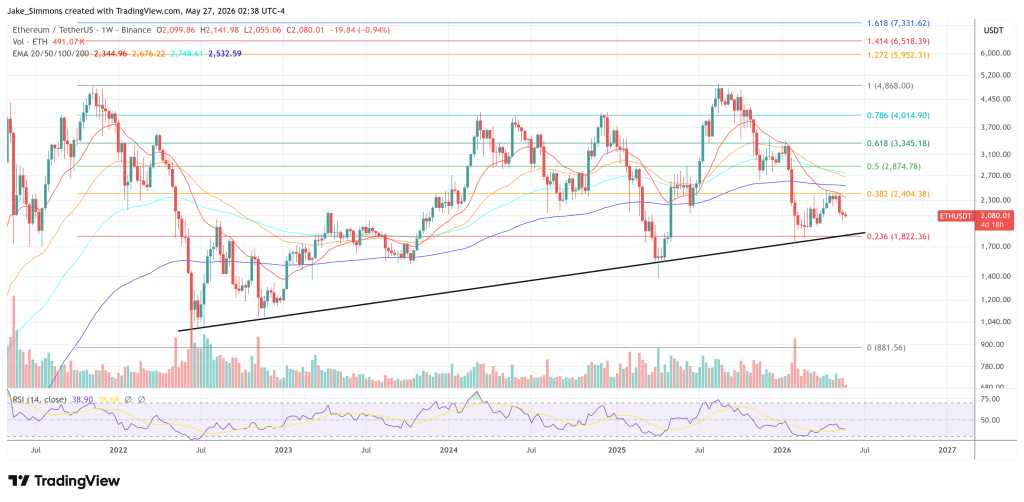
Ethereum price chart
Disclaimer: For information purposes only. Past performance is not indicative of future results.
placeholder
Bitcoin CME gaps at $35,000, $27,000 and $21,000, which one gets filled first?Prioritize filling the $27,000 gap and even try higher.
Author  FXStreet
Aug 22, 2023
Prioritize filling the $27,000 gap and even try higher.
placeholder
Pinduoduo Earnings Incoming: Morgan Stanley Sees Long-Term Profit Potential​Insights – On November 21, Chinese e-commerce giant Pinduoduo (PDD) will release its Q3 2024 earnings.
Author  Mitrade
Nov 20, 2024
​Insights – On November 21, Chinese e-commerce giant Pinduoduo (PDD) will release its Q3 2024 earnings.
placeholder
Elon Musk’s xAI and Neuralink Launch New Funding Rounds​Billionaire Elon Musk recently raised funds for his two high-profile tech companies, xAI and Neuralink.
Author  Insights
Jun 03, 2025
​Billionaire Elon Musk recently raised funds for his two high-profile tech companies, xAI and Neuralink.
placeholder
Bitcoin briefly loses 2025 gains as crypto plunges over the weekend.Bitcoin experienced a sharp decline this weekend, briefly erasing its 2025 gains and dipping below its year-opening value of $93,507. The cryptocurrency fell to a low of $93,029 on Sunday, representing a 25% drop from its all-time high in October. Although it has rebounded slightly to around $94,209, the pressures on the market remain significant. The downturn occurred despite the reopening of the U.S. government on Thursday, which many had hoped would provide essential support for crypto markets. This year initially appeared promising for cryptocurrencies, particularly after the inauguration of President Donald Trump, who has established the most pro-crypto administration thus far. However, ongoing political tensions—including Trump's tariff strategies and the recent government shutdown, lasting a historic 43 days—have contributed to several rapid price pullbacks for Bitcoin throughout the year. Market dynamics are also being influenced by Bitcoin whales—investors holding large amounts of Bitcoin—who have been offloading portions of their assets, consequently stalling price rallies even as positive regulatory developments emerge. Despite these sell-offs, analysts from Glassnode argue that this behavior aligns with typical patterns seen among long-term investors during the concluding stages of bull markets, suggesting it is not indicative of a mass exodus. Notably, Bitcoin is not alone in its struggles, as Ethereum and Solana have also recorded declines of 7.95% and 28.3%, respectively, since the start of the year, while numerous altcoins have faced even steeper losses. Looking ahead, questions linger regarding the viability of the four-year cycle thesis, particularly given the increasing institutional support and regulatory frameworks now in place in the crypto landscape. Matt Hougan, chief investment officer at Bitwise, remains optimistic, suggesting a potential Bitcoin resurgence in 2026 driven by the “debasement trade” thesis and a broader trend toward increased adoption of stablecoins, tokenization, and decentralized finance. Hougan emphasized the soundness of the underlying fundamentals, pointing to a positive outlook for the sector in the longer term.
Author  Mitrade
Nov 17, 2025
Bitcoin experienced a sharp decline this weekend, briefly erasing its 2025 gains and dipping below its year-opening value of $93,507. The cryptocurrency fell to a low of $93,029 on Sunday, representing a 25% drop from its all-time high in October. Although it has rebounded slightly to around $94,209, the pressures on the market remain significant. The downturn occurred despite the reopening of the U.S. government on Thursday, which many had hoped would provide essential support for crypto markets. This year initially appeared promising for cryptocurrencies, particularly after the inauguration of President Donald Trump, who has established the most pro-crypto administration thus far. However, ongoing political tensions—including Trump's tariff strategies and the recent government shutdown, lasting a historic 43 days—have contributed to several rapid price pullbacks for Bitcoin throughout the year. Market dynamics are also being influenced by Bitcoin whales—investors holding large amounts of Bitcoin—who have been offloading portions of their assets, consequently stalling price rallies even as positive regulatory developments emerge. Despite these sell-offs, analysts from Glassnode argue that this behavior aligns with typical patterns seen among long-term investors during the concluding stages of bull markets, suggesting it is not indicative of a mass exodus. Notably, Bitcoin is not alone in its struggles, as Ethereum and Solana have also recorded declines of 7.95% and 28.3%, respectively, since the start of the year, while numerous altcoins have faced even steeper losses. Looking ahead, questions linger regarding the viability of the four-year cycle thesis, particularly given the increasing institutional support and regulatory frameworks now in place in the crypto landscape. Matt Hougan, chief investment officer at Bitwise, remains optimistic, suggesting a potential Bitcoin resurgence in 2026 driven by the “debasement trade” thesis and a broader trend toward increased adoption of stablecoins, tokenization, and decentralized finance. Hougan emphasized the soundness of the underlying fundamentals, pointing to a positive outlook for the sector in the longer term.
placeholder
Gold edges higher above $4,550 on US-Iran peace optimism Gold price (XAU/USD) gains ground to near $4,575 during the early Asian session on Tuesday. The precious metal edges higher as hopes for US-Iran peace negotiations weakened the US Dollar (USD). 
Author  FXStreet
Yesterday 01: 21
Gold price (XAU/USD) gains ground to near $4,575 during the early Asian session on Tuesday. The precious metal edges higher as hopes for US-Iran peace negotiations weakened the US Dollar (USD). 
goTop
quote