

Pound Sterling drops as UK PM Starmer supports lower interest rates
- The Pound Sterling faces pressure against its major currency peers amid dovish BoE expectations.
- UK PM Starmer seeks lower rates to boost economy, BoE’s Greene to support rate cuts if employment and consumption fall further.
- Weak US ISM Manufacturing PMI data indicate a soft demand environment.
The Pound Sterling (GBP) trades slightly lower against its major peers on Tuesday as United Kingdom (UK) Prime Minister (PM) Keir Starmer stresses bringing inflation and interest rates down to boost business investment and economic growth.
While addressing reporters on Monday, UK PM Starmer said, “The most important things that we can do for growth, the most important things that we can do for business is first to drive inflation down so that interest rates come down further, and the cost of business investment comes down with it,” Reuters reported.
These comments from Starmer came while praising the Autumn budget announced by Chancellor of the Exchequer Rachel Reeves last week, in which she raised taxes by 26 billion pounds by 2029-30 to fill the fiscal gap.
The scenario of lower UK interest rates bodes poorly for the Pound Sterling.
Meanwhile, traders are also confident that the Bank of England (BoE) will cut interest rates in the monetary policy meeting this month amid weakness in the job market and slowing inflation growth.
Contrary to firm dovish BoE market expectations, policymaker Megan Greene stated on Monday that she would support interest rate cuts only if the labour market and consumption deteriorate further.
Daily digest market movers: Pound Sterling consolidates against US Dollar
- The Pound Sterling flattens around 1.3220 against the US Dollar (USD) during the European trading session on Tuesday. The GBP/USD pair consolidates as the US Dollar turns sideways after recovering on Monday despite weak United States (US) ISM Manufacturing Purchasing Managers’ Index (PMI) data for November.
- At press time, the US Dollar Index (DXY), which tracks the Greenback’s value against six major currencies, holds onto Monday’s recovery move around 99.40.
- The US economic data showed on Monday that activities in the factory sector contracted for the ninth month in a row. Also, the pace of contraction in the manufacturing sector activity was faster than projected. The Manufacturing PMI landed at 48.2, lower than estimates of 48.6 and from 48.7 in October.
- In addition to the Manufacturing PMI, other sub-components of the non-service sector, such as New Orders and Employment Indexes also came in significantly lower than their former readings. The overall weakness in the manufacturing sector exhibits a weak demand environment, which, in theory, underpins the need for further interest rate cuts by the Federal Reserve (Fed).
- Currently, traders are increasingly confident that the Fed will cut interest rates again this year. The central bank has already reduced the Federal Fund Rate by 75 basis points (bps) to 3.75%-4.00% this year. According to the CME FedWatch tool, there is an 87.2% chance that the Fed will cut rates by 25 basis points (bps) to 3.50%-3.75% in the December monetary policy meeting.
- Going forward, major triggers for the US Dollar will be the ADP Employment Change and the ISM Services PMI data for November, which are scheduled for Wednesday. The ADP report is expected to show that private employers added 10K fresh workers, significantly lower than 42K in October. Meanwhile, the ISM Services PMI is seen lower at 52.1 from 52.4 in October.
Technical Analysis: GBP/USD stabilizes above 20-day EMA
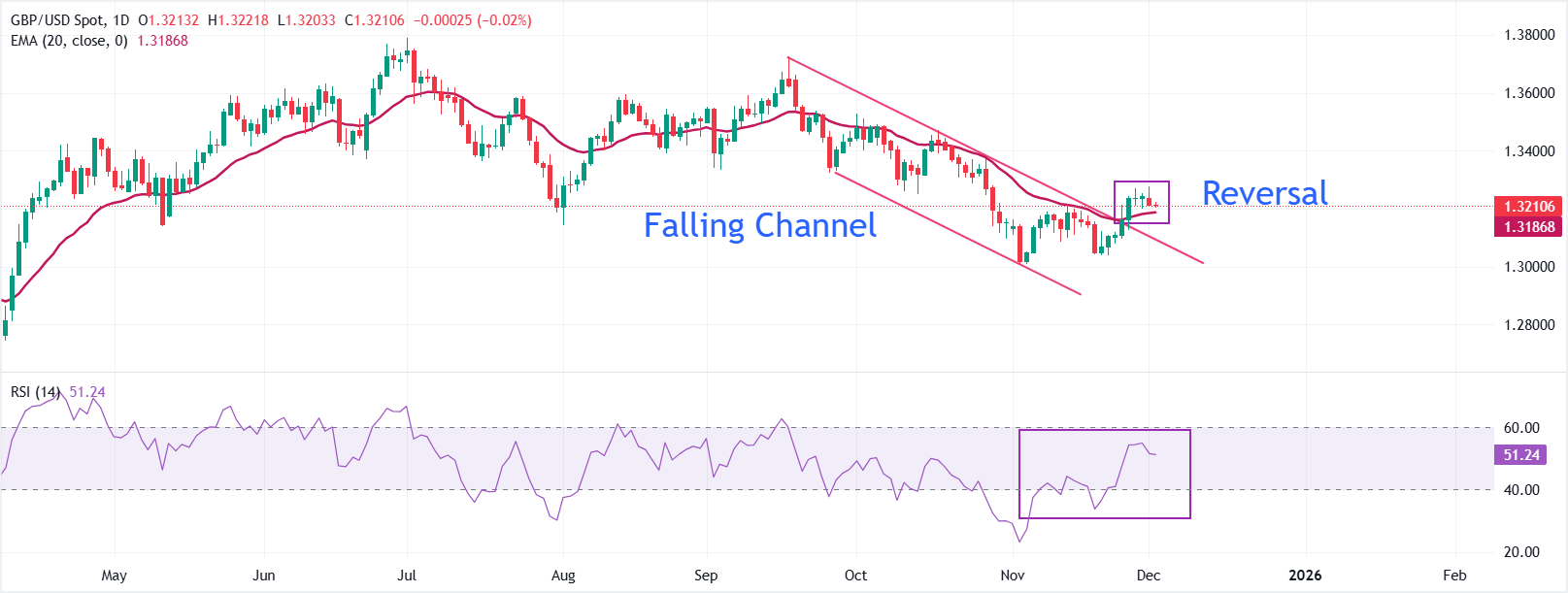
GBP/USD trades at 1.3211 during the European trading session on Tuesday on the daily chart. The pair holds marginally above the rising 20-day Exponential Moving Average (EMA) at 1.3187, keeping the short-term bias pointed higher. The average has begun to turn up after a flattening phase, signaling improving trend conditions.
The 14-day Relative Strength Index (RSI) stands at 51.24, neutral, as momentum stabilizes after the recent rebound.
The break above the descending trend line, coming from 1.3726, at 1.3085 earlier in the move, confirmed a shift in bias, with the former cap no longer obstructing the topside.
With the trend-line breach validated, dips would stay contained while buyers defend higher lows. A pullback toward 1.3085 could attract demand, whereas a daily close beneath that area would negate the bullish bias and risk a deeper retracement towards the psychological level of 1.3000.
(The technical analysis of this story was written with the help of an AI tool)
Pound Sterling FAQs
The Pound Sterling (GBP) is the oldest currency in the world (886 AD) and the official currency of the United Kingdom. It is the fourth most traded unit for foreign exchange (FX) in the world, accounting for 12% of all transactions, averaging $630 billion a day, according to 2022 data. Its key trading pairs are GBP/USD, also known as ‘Cable’, which accounts for 11% of FX, GBP/JPY, or the ‘Dragon’ as it is known by traders (3%), and EUR/GBP (2%). The Pound Sterling is issued by the Bank of England (BoE).
The single most important factor influencing the value of the Pound Sterling is monetary policy decided by the Bank of England. The BoE bases its decisions on whether it has achieved its primary goal of “price stability” – a steady inflation rate of around 2%. Its primary tool for achieving this is the adjustment of interest rates. When inflation is too high, the BoE will try to rein it in by raising interest rates, making it more expensive for people and businesses to access credit. This is generally positive for GBP, as higher interest rates make the UK a more attractive place for global investors to park their money. When inflation falls too low it is a sign economic growth is slowing. In this scenario, the BoE will consider lowering interest rates to cheapen credit so businesses will borrow more to invest in growth-generating projects.
Data releases gauge the health of the economy and can impact the value of the Pound Sterling. Indicators such as GDP, Manufacturing and Services PMIs, and employment can all influence the direction of the GBP. A strong economy is good for Sterling. Not only does it attract more foreign investment but it may encourage the BoE to put up interest rates, which will directly strengthen GBP. Otherwise, if economic data is weak, the Pound Sterling is likely to fall.
Another significant data release for the Pound Sterling is the Trade Balance. This indicator measures the difference between what a country earns from its exports and what it spends on imports over a given period. If a country produces highly sought-after exports, its currency will benefit purely from the extra demand created from foreign buyers seeking to purchase these goods. Therefore, a positive net Trade Balance strengthens a currency and vice versa for a negative balance.
Recommended Articles


