




Silver Has Tumbled 46% From its Peak to $66 an Ounce. Is This Top Silver ETF Still a Buy?
Key Points
Silver’s rally fizzled out over the past five months.
Several major challenges could limit its near-term gains.
- 10 stocks we like better than iShares Silver Trust ›
On Jan. 29, the price of silver reached its all-time high of $121.67 per troy ounce, quadrupling from $30.38 per ounce a year earlier. At the time, robust industrial demand, feverish investor demand, and production bottlenecks all drove its price higher.
But since hitting that peak, it's declined 46% to $66 per ounce. Let's see why it pulled back -- and if it's the right time to buy silver via the iShares Silver Trust ETF (NYSEMKT: SLV).
Will AI create the world's first trillionaire? Our team just released a report on the one little-known company, called an "Indispensable Monopoly" providing the critical technology Nvidia and Intel both need. Continue »
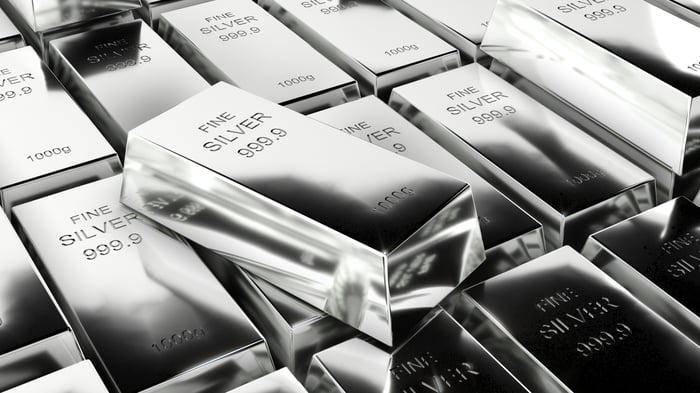
Image source: Getty Images.
Why did silver's price decline again?
Three catalysts fueled silver's rally last year. First, the market's demand for silver to produce solar panels, electric vehicles, consumer electronics, and data centers outstripped the global supply. The explosive growth of the cloud and AI markets was a major factor.
Second, declining ore grades, rising production costs, and tighter environmental regulations exacerbated that pressure by preventing silver miners from producing enough silver. Lastly, expectations of additional interest rate cuts -- which generally weaken the U.S. dollar -- drove more investors to accumulate silver and gold as safe-haven assets.
However, three challenges ended that rally. First, more than half of silver's global demand came from industrial manufacturers. Rising inflation and high interest rates eventually forced those companies to rein in their spending.
Second, silver became prohibitively expensive at its all-time high -- so many companies shifted toward processes that used less silver or cheaper metals like copper. Gold isn't as exposed to those macro challenges, since it isn't as widely used in industry as silver.
Lastly, the outbreak of the Iran war in late February, which drove up oil prices and exacerbated inflation, sparked fears of rate hikes. Rising interest rates will strengthen the U.S. dollar and weaken silver, gold, and other assets priced in U.S. dollars.
Is it the right time to buy SLV?
The iShares Silver Trust ETF, which manages $32.5 billion in assets, is the world's largest silver ETF and an easy way to invest in the precious metal. But the ETF also charges an annual sponsor fee of 0.50%, which is paid by selling some of its own silver, so each share will represent less physical silver over time, reducing your long-term returns. That's why it rose only 231% over the past 10 years, while the spot price of silver increased 351%.
Therefore, it would be smarter to buy physical silver or a cheaper silver ETF, such as the abrdn Physical Silver Shares ETF (NYSEMKT: SIVR), which has a net expense ratio of 0.30%. That said, I wouldn't rush to buy silver right now, since the aforementioned headwinds could drive it lower -- and its real-world uses will ultimately cap its near-term gains.
Should you buy stock in iShares Silver Trust right now?
Before you buy stock in iShares Silver Trust, consider this:
The Motley Fool Stock Advisor analyst team just identified what they believe are the 10 best stocks for investors to buy now… and iShares Silver Trust wasn’t one of them. The 10 stocks that made the cut could produce monster returns in the coming years.
Consider when Netflix made this list on December 17, 2004... if you invested $1,000 at the time of our recommendation, you’d have $445,672!* Or when Nvidia made this list on April 15, 2005... if you invested $1,000 at the time of our recommendation, you’d have $1,280,566!*
Now, it’s worth noting Stock Advisor’s total average return is 948% — a market-crushing outperformance compared to 206% for the S&P 500. Don't miss the latest top 10 list, available with Stock Advisor, and join an investing community built by individual investors for individual investors.
See the 10 stocks »
*Stock Advisor returns as of June 9, 2026.
Leo Sun has no position in any of the stocks mentioned. The Motley Fool has no position in any of the stocks mentioned. The Motley Fool has a disclosure policy.
Recommended Articles


