




Prediction: This Artificial Intelligence (AI) Semiconductor Stock Will Go Parabolic in June (Hint: It's Not Nvidia)
Key Points
Shares of Micron Technology have soared nearly 50% over the last month.
Micron's rally is supported by the ongoing build-out of artificial intelligence infrastructure.
Micron's management expects that the memory chip shortage will last at least through next year.
- 10 stocks we like better than Micron Technology ›
For a few years now, investors have treated Nvidia as the primary barometer measuring the health of the artificial intelligence (AI) sector. While the GPU leader remains a core pillar supporting the infrastructure boom, Micron Technology (NASDAQ: MU) has emerged as another big name fueling the AI semiconductor space.
On June 24, Micron is scheduled to report earnings for its fiscal 2026 third quarter, and expectations couldn't be higher. Over the last month, Micron's stock price has skyrocketed nearly 50%, earning it a spot on the short list of trillion-dollar companies.
Will AI create the world's first trillionaire? Our team just released a report on the one little-known company, called an "Indispensable Monopoly" providing the critical technology Nvidia and Intel both need. Continue »
While having that kind of vertical move in the immediate rear-view mirror would normally suggest that investors behave with caution, I think the setup for Micron stock remains compelling. Its rally may not be over yet.

Image source: Micron Technology.
Why is Micron stock rallying?
Micron's recent surge was far from speculative. Instead, the company's trajectory is supported by two powerful, interlocking fundamentals.
First, AI hyperscalers -- Amazon, Microsoft, Alphabet, and Meta Platforms -- are accelerating their capital expenditures on AI infrastructure at a pace most analysts didn't anticipate even a year ago. Training large language models and handling inference workloads demand massive amounts of high-bandwidth memory (HBM) and dynamic random-access memory (DRAM) layered on top of graphics processing units (GPUs). These memory solutions are exactly the products that Micron delivers.
Second, rising adoption of AI has flipped the memory market from cyclical oversupply to an acute shortage across DRAM and NAND. As utilization rates for memory and storage rise amid, producers like Micron gain immense pricing power.
What does Wall Street expect for Micron's third-quarter earnings?
Micron's internal revenue guidance for its fiscal Q3 is $33.5 billion, plus or minus $750 million. Moreover, the company is calling for earnings per share (EPS) of $18.90, plus or minus $0.40. Interestingly, Wall Street's consensus expectations are a little higher than those medians -- revenue of $33.8 billion and EPS of $19.31.
Even if Micron's revenue lands at precisely the midpoint of its guidance, that would still represent 260% year-over-year growth. Furthermore, the company's EPS forecast is nearly 10 times what Micron reported just one year ago. This level of accelerating growth leads me to think that with Micron's current pricing power, it could deliver a sizable beat and raise when the company reports earnings later this month.
Supporting that premise, Micron's top peers, SK Hynix and Samsung, recently posted record quarterly results driven by the same AI-driven memory tailwinds -- confirming that demand is real and sticky.
On top of this, Micron's long-term agreement contract structure provides another layer of visibility and insulation that the company did not enjoy during prior tech booms. Taken together, the combination of pricing leverage, peer momentum, and contractual stability positions Micron to beat Wall Street's expectations.
Can Micron stock keep climbing?
Even after a meteoric run over the past year that has lifted the stock by close to 800%, I think a strong earnings report could propel Micron stock higher as the narrative around this memory specialist continues its shift from "historically cyclical" to "secular AI winner." Recent price target upgrades from Wall Street help underscore this transition.
Analysts from DA Davidson, Susquehanna, and UBS have all significantly lifted their price targets and reiterated bullish stances on Micron in recent weeks. The average price forecast among these three firms is about $1,625 -- implying roughly 70% upside from Micron's current trading levels.
One thing to point out is that in the wake of Micron's recent valuation expansion, the stock could be viewed as being priced for perfection. Against this backdrop, the biggest risk around Micron is not an earnings miss. It's that blowout quarterly results could be followed by a "sell the news" dip, given that any perceived disappointment in management's guidance could trigger profit-taking.
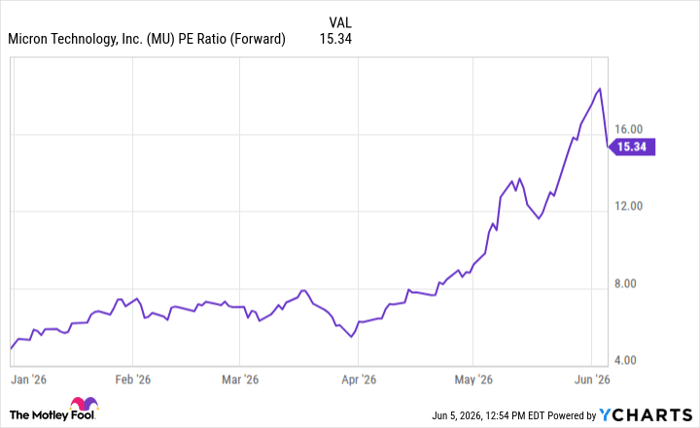
MU PE Ratio (Forward) data by YCharts.
Nevertheless, the analyst community's collective upgrade cycle right before an earnings report suggests Wall Street is looking beyond short-term volatility and indexing more heavily on Micron's multiyear opportunity as AI infrastructure build-outs continue. For this reason, I think Micron stock is positioned for a sustained, sharp upward movement following the company's highly anticipated report later this month.
Should you buy stock in Micron Technology right now?
Before you buy stock in Micron Technology, consider this:
The Motley Fool Stock Advisor analyst team just identified what they believe are the 10 best stocks for investors to buy now… and Micron Technology wasn’t one of them. The 10 stocks that made the cut could produce monster returns in the coming years.
Consider when Netflix made this list on December 17, 2004... if you invested $1,000 at the time of our recommendation, you’d have $445,672!* Or when Nvidia made this list on April 15, 2005... if you invested $1,000 at the time of our recommendation, you’d have $1,280,566!*
Now, it’s worth noting Stock Advisor’s total average return is 948% — a market-crushing outperformance compared to 206% for the S&P 500. Don't miss the latest top 10 list, available with Stock Advisor, and join an investing community built by individual investors for individual investors.
See the 10 stocks »
*Stock Advisor returns as of June 9, 2026.
Adam Spatacco has positions in Alphabet, Amazon, Meta Platforms, Microsoft, and Nvidia. The Motley Fool has positions in and recommends Alphabet, Amazon, Meta Platforms, Micron Technology, Microsoft, and Nvidia. The Motley Fool has a disclosure policy.
Recommended Articles


