




This Top Artificial Intelligence (AI) Stock Is Benefiting From the Next Infrastructure Bottleneck, and It Just Became an Attractive Buy
Key Points
The demand for fast networking in AI data centers is creating a shortage of optical networking components.
The supply shortage has been driving up prices of these components, leading to a sharp increase in revenue and earnings for Ciena.
Ciena stock fell following its latest quarterly report, but investors will do well to take a look at the bigger picture.
- 10 stocks we like better than Ciena ›
Artificial intelligence (AI) infrastructure investments have been booming this year, with the top four hyperscalers in the U.S. expected to splurge a staggering $725 billion in capital spending in 2026.
That's a 77% increase over last year's $410 billion capital expenditure incurred by Google, Amazon, Meta Platforms, and Microsoft. These hyperscalers are sitting on massive backlogs, fueled by the phenomenal demand for their AI services. However, the scope of AI spending isn't limited to these hyperscalers, as pure-play AI companies, such as OpenAI and Anthropic, and neocloud providers, such as CoreWeave and Nebius, are also rapidly scaling up their infrastructure.
Will AI create the world's first trillionaire? Our team just released a report on the one little-known company, called an "Indispensable Monopoly" providing the critical technology Nvidia and Intel both need. Continue »
Not surprisingly, there is a shortage of several components that power AI data center infrastructure, such as graphics processing units (GPUs), server processors, and memory chips. There is another mission-critical component that's now in overwhelming demand due to the AI infrastructure build-out, and it is expected to create the next bottleneck -- optical networking.
Ciena (NYSE: CIEN) is one of the top players in the optical networking space, and it has been reaping the benefits of the solid demand for these components. The company recently released its results, and the stock price action following its quarterly report suggests investors have a great opportunity to buy this fast-growing AI stock.
Here's why.

Image source: The Motley Fool.
Ciena's growth is picking up as AI fuels solid demand for optical components
Optical networking components help transport enormous amounts of data in AI data centers and GPU clusters. As the name suggests, optical networking uses light rather than traditional copper cables to move data, which is why it offers high bandwidth, energy efficiency, and low latency. So, using optical transport networks means that GPUs and other AI accelerator chips won't be sitting idle for data to arrive, allowing them to quickly execute tasks.
This explains why Ciena reported a 40% year-over-year increase in revenue for the second quarter of fiscal 2026 (which ended on May 2) to $1.57 billion. That was faster than the 33% revenue jump Ciena saw in fiscal Q1. What's more, the supply shortage in optical networking means the prices of these components are rising.
That's why Ciena's operating margin more than doubled year over year in the previous quarter to 19.5%. The company's non-GAAP earnings per share jumped by a stunning 290% from the year-ago period to $1.64 per share. Its revenue and earnings were well ahead of consensus estimates. Even better, the company has raised its full-year revenue guidance to $6.3 billion from the earlier estimate of $6.1 billion.
The updated guidance suggests that Ciena's top line will increase by 32% at the midpoint this fiscal year. However, don't be surprised if its growth comes in hotter than expected, as the company anticipates its addressable market to jump significantly. CEO Gary Smith noted on the latest earnings call:
Simply put, all customers are prioritizing high capacity, low latency, and high-speed connectivity, underpinned by the need to transport data for AI, including model training, data ingestion, and inference. To that end, our latest view is that the addressable market will approximately double over the next several years to roughly $50 billion by 2029.
Importantly, Ciena is winning more business from hyperscalers to deploy its optical components, which should allow it to convert that sizable market opportunity into revenue and earnings growth. Moreover, the supply of optical components is anticipated to remain significantly below demand through 2029, according to McKinsey, ensuring that Ciena's strong pricing power remains sustainable.
The company ended the latest quarter with an order backlog of $7.7 billion, up $600 million from the prior quarter. So, there is a strong chance Ciena's growth will outpace its guidance this year. Moreover, the $50 billion revenue opportunity that Ciena sees over the next three years, along with the supply shortage, should be a catalyst for phenomenal earnings growth.
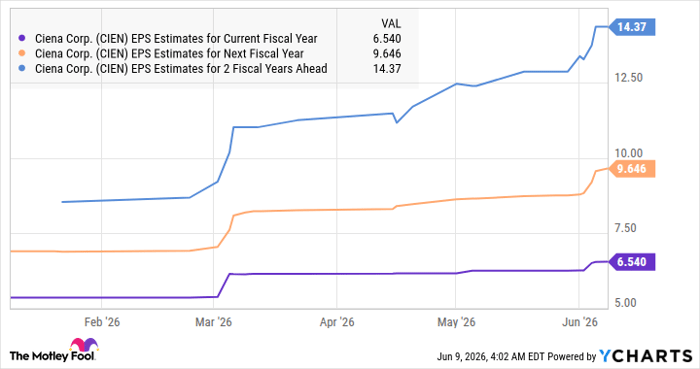
Data by YCharts
The chart above shows that Ciena's earnings will more than double over the next couple of fiscal years, though the discussion above makes it clear it could do even better.
The stock is down, creating an opportunity for savvy investors
Ciena's stock dropped over 13% after releasing its report on June 4 despite the beat-and-raise report. The drop doesn't seem justified, though it is worth noting that the company has a premium valuation. It trades at 163 times trailing earnings, and the forward earnings multiple of 79 isn't cheap either. For comparison, the tech-focused Nasdaq Composite index has an average price-to-earnings ratio of 40.
However, Ciena's remarkable earnings growth justifies the valuation. Ciena delivered $2.64 in earnings per share in fiscal 2025 (which ended on Nov. 1, 2025). The consensus estimate of $14.37 in earnings per share for fiscal 2028 (as seen in the previous chart) suggests that its bottom line will increase at a compound annual growth rate (CAGR) of 76% for the next three years.
Assuming Ciena clocks even 30% annual earnings growth in fiscal 2029 and 2030, its bottom line could reach $18.68 in the next five years. If it trades at 40 times earnings at that time, in line with the Nasdaq Composite but at a significant discount to its current multiple, its stock price could jump to $747. That's a potential upside of 60%, which is why investors can consider using the drop in this tech stock as a buying opportunity.
Of course, Ciena can deliver significantly stronger upside during this period as it benefits from a key bottleneck in AI infrastructure that should continue to drive up the price of its products, eventually leading to market-beating earnings growth over the long run.
Should you buy stock in Ciena right now?
Before you buy stock in Ciena, consider this:
The Motley Fool Stock Advisor analyst team just identified what they believe are the 10 best stocks for investors to buy now… and Ciena wasn’t one of them. The 10 stocks that made the cut could produce monster returns in the coming years.
Consider when Netflix made this list on December 17, 2004... if you invested $1,000 at the time of our recommendation, you’d have $445,672!* Or when Nvidia made this list on April 15, 2005... if you invested $1,000 at the time of our recommendation, you’d have $1,280,566!*
Now, it’s worth noting Stock Advisor’s total average return is 948% — a market-crushing outperformance compared to 206% for the S&P 500. Don't miss the latest top 10 list, available with Stock Advisor, and join an investing community built by individual investors for individual investors.
See the 10 stocks »
*Stock Advisor returns as of June 9, 2026.
Harsh Chauhan has no position in any of the stocks mentioned. The Motley Fool has positions in and recommends Amazon, Ciena, Meta Platforms, and Microsoft. The Motley Fool has a disclosure policy.
Recommended Articles


