




What a Kevin Warsh-Led Fed Means for Big Banks Like JPMorgan Chase and Bank of America
Key Points
Monetary policy affects different banking businesses in different ways.
The Federal Reserve also has significant authority in regulating banks.
Kevin Warsh's approach to both aspects is very different from that of former Fed Chairman Jerome Powell.
- These 10 stocks could mint the next wave of millionaires ›
Kevin Warsh is now chairman of the Federal Reserve's Board of Governors. If past comments from Warsh are any indication, then big changes could be coming to the Fed and the banking industry.
Warsh has spoken publicly about how he thinks the Fed has played too large a role in financial markets, whether through its transparency about future interest rate policy or the size of the Fed's balance sheet.
Will AI create the world's first trillionaire? Our team just released a report on the one little-known company, called an "Indispensable Monopoly" providing the critical technology Nvidia and Intel both need. Continue »
It's also worth noting that the Fed regulates bank holding companies and has significant control over bank regulation, particularly for large banks. Here's what a Warsh-led Fed means for big banks like JPMorgan Chase (NYSE: JPM) and Bank of America.
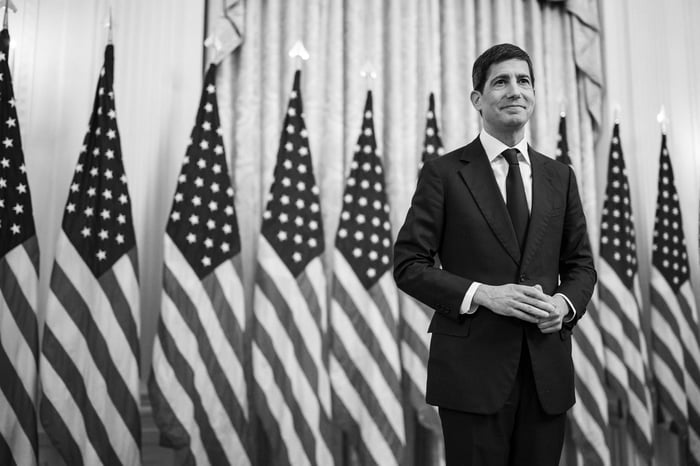
Official White House Photo by Daniel Torok.
Banks are looking at a higher-for-longer rate environment
It's hard to know exactly what approach Warsh will take to interest rates as the new board chair.
In the months leading up to his confirmation for the role, Warsh seemed to suggest that artificial intelligence productivity gains would pave the way for the Fed to cut interest rates. However, recent economic data is really forcing his hand in the opposite direction.
The labor market has seemingly firmed up during the past three months and now seems to be on solid footing. Meanwhile, inflation remains above the Fed's 2% target, so Warsh's hands are tied right now. The market widely expects Warsh to keep rates unchanged for his first several meetings, with the Fed's next move now expected to be an interest rate hike.
Warsh has talked about changing the way the Fed looks at inflation, but that framework could take some time to develop, so banks probably can expect a higher-for-longer rate environment.
Assuming the yield curve remains steep, meaning shorter-duration bonds continue to yield less than longer-duration ones, this can actually be favorable to bank lending businesses. Banks tend to borrow money short-term at low rates and lend it out long-term at higher rates, so a steep yield curve allows them to make a spread between the money they pay for deposits and the money they earn on loans and bonds.
Bank of America and JPMorgan Chase both predict net interest income to rise about 7% or more in 2026 from the previous year.
Higher-for-longer rates aren't always so great for investment banking and asset and wealth management, but other factors also affect these businesses, namely, artificial intelligence.
Trillion-dollar initial public offerings (IPOs) are helping the large investment banks earn enormous fees, while AI in general continues to move the market broadly higher, which is good for asset and wealth management.
The flip side of higher rates is that they can pressure consumer and business balance sheets, as well as real estate. This can lead to depressed lending activity or higher loan losses.
How a smaller Fed balance sheet could impact banks
Warsh has also been vocal about his desire to shrink the Fed's $6.7 trillion balance sheet. Warsh believes a larger Fed balance sheet and more liquidity in the economy favor wealthier people with assets and provide too much support to financial markets.
This will take time because shrinking the Fed's balance sheet can be tricky. However, in general, a smaller Fed balance sheet will have both pros and cons for large banks like JPMorgan Chase and Bank of America.
It would likely hurt banks because removing liquidity can slow the economy, and large banks are closely tied to the health of the U.S. economy. Less liquidity could mean tighter lending conditions and less money sloshing around that can work its way into private equity, venture capital, stocks, and other alternative assets.
However, the Fed has previously gotten into trouble when it shrank its balance sheet too quickly, lowering bank reserves that many financial players rely on. In 2019, reserves drained too quickly, triggering excess demand in the overnight repo market and causing short-term repo rates to soar. The Fed eventually had to inject liquidity.
On the other hand, shrinking the Fed's balance sheet can also steepen the yield curve because the Fed is no longer buying various bonds. So, as debt is issued by the government, there would likely be a larger supply of bonds in the market, which would decrease demand, leading to lower bond prices and higher bond yields.
Additionally, if Warsh is able to eventually cut interest rates, which he certainly wants to do whenever feasible, that would likely further bring down the yields on shorter-duration bonds, which tend to be more heavily influenced by the federal funds rate controlled by the Fed.
That could really steepen the yield curve, which, as I mentioned, would likely be great for bank lending businesses.
Warsh has previously favored bank deregulation
Finally, as one of the key bank regulators, Warsh seems more likely to favor deregulation, which the large banks have already begun to enjoy under President Donald Trump.
"I don't believe the Fed is owed any particular deference in bank regulatory and supervisory policy," Warsh said in a Wall Street Journal opinion column last year, adding the U.S. Treasury Department should play a larger role in bank regulation.
Based on these comments, Warsh is likely to push for less bank regulation by the Fed, which would likely translate into easier annual stress testing and support for lower regulatory capital and liquidity requirements, all of which are favorable for large banks.
It also likely means faster approvals for large bank mergers and acquisitions, although JPMorgan Chase and Bank of America can't typically acquire banks directly because they already have more than 10% U.S. deposit market share.
Ultimately, Warsh should be favorable for large banks in terms of regulation.
Where to invest $1,000 right now
When our analyst team has a stock tip, it can pay to listen. After all, Stock Advisor’s total average return is 941%* — a market-crushing outperformance compared to 206% for the S&P 500.
They just revealed what they believe are the 10 best stocks for investors to buy right now, available when you join Stock Advisor.
See the stocks »
*Stock Advisor returns as of June 9, 2026.
Bank of America is an advertising partner of Motley Fool Money. JPMorgan Chase is an advertising partner of Motley Fool Money. Bram Berkowitz has no position in any of the stocks mentioned. The Motley Fool has positions in and recommends JPMorgan Chase. The Motley Fool has a disclosure policy.
Recommended Articles


