




Down 22%, 3 Reasons to Buy the Dip on Amazon Stock
Key Points
Amazon Web Services continues to see robust demand for its AI tools from commercial and government customers.
Amazon's numerous competitive strengths widen its economic moat.
Investors can pay an attractive valuation for durable revenue and profit growth.
- 10 stocks we like better than Amazon ›
Shares of Amazon (NASDAQ: AMZN) currently trade 22% below their peak from November 2025 (as of Feb. 17). More recently, the market became weary when the business announced plans for $200 billion in capital expenditures in 2026. This investment, up from $131 billion last year, is meant to support Amazon's artificial intelligence (AI) efforts.
It's time to take advantage of the opportunity. Here are three reasons investors should buy the dip on this "Magnificent Seven" stock.
Will AI create the world's first trillionaire? Our team just released a report on the one little-known company, called an "Indispensable Monopoly" providing the critical technology Nvidia and Intel both need. Continue »
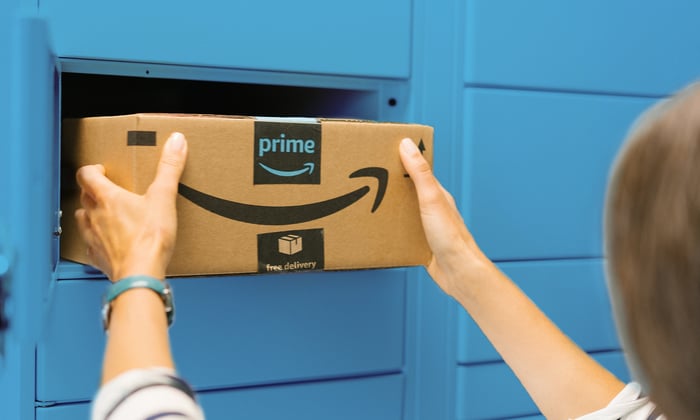
Image source: Amazon.
1. A strong position in AI
The tech titans are showing that they are leading the AI race, and Amazon falls into this category. That $200 billion sum, while a huge figure, will go toward expanding technical infrastructure to help ensure that the company will stay ahead of the pack.
The concerns about Amazon producing a satisfactory return on this investment are justified. But the success of Amazon Web Services (AWS), which posted accelerating revenue growth of 24% in the fourth quarter (ended Dec. 31), should ease any worries for now. The segment is registering robust demand for AI products and services, so management believes that it's necessary to expand computing capacity.
"AWS continues to earn most of the big enterprise and government transitions to cloud," CEO Andy Jassy said on the quarterly 2025 earnings call. "More of the top 500 U.S. start-ups use AWS as their primary cloud provider than the next two providers combined."
2. A wide economic moat
Amazon's durable competitive advantages, which make up its wide economic moat, are another reason to buy the stock.
Scale provides a clear cost advantage. This is true with the logistics network facilitating fast and free shipments of products from its online marketplace. It's also evident in AWS, as huge fixed investments early on have now resulted in impressive profitability.
The online marketplace benefits from a network effect. More merchants improve the value proposition for shoppers, which brings in more sellers.
AWS customers also deal with high switching costs. It would be a nightmare trying to change to another cloud provider, given that companies' workflows are integrated and employees are onboarded with AWS.
3. Ongoing revenue and profit growth
In the past decade, Amazon's revenue and operating income have increased by 570% and 3,536%, respectively. Growth rates will decline in the future, but the gains are durable. That's because the company is riding multiple secular tailwinds -- like AI, cloud computing, online shopping, and digital advertising -- that should keep the business moving forward far into the future.
To add this kind of sustainable growth to their portfolios, investors are being asked to pay a price-to-earnings ratio of 28. That's near a 10-year low. It's time to consider buying the dip on Amazon stock.
Should you buy stock in Amazon right now?
Before you buy stock in Amazon, consider this:
The Motley Fool Stock Advisor analyst team just identified what they believe are the 10 best stocks for investors to buy now… and Amazon wasn’t one of them. The 10 stocks that made the cut could produce monster returns in the coming years.
Consider when Netflix made this list on December 17, 2004... if you invested $1,000 at the time of our recommendation, you’d have $415,256!* Or when Nvidia made this list on April 15, 2005... if you invested $1,000 at the time of our recommendation, you’d have $1,151,865!*
Now, it’s worth noting Stock Advisor’s total average return is 892% — a market-crushing outperformance compared to 194% for the S&P 500. Don't miss the latest top 10 list, available with Stock Advisor, and join an investing community built by individual investors for individual investors.
See the 10 stocks »
*Stock Advisor returns as of February 20, 2026.
Neil Patel has no position in any of the stocks mentioned. The Motley Fool has positions in and recommends Amazon. The Motley Fool has a disclosure policy.
Recommended Articles


