




US May CPI Preview: Rising Inflation May Push Up Fed Rate Hike Expectations, How Will US Stocks, Dollar, Gold React?
TradingKey - The U.S. Bureau of Labor Statistics will release May CPI data at 8:30 AM ET on June 10. This report is the most critical inflation reading ahead of the Federal Reserve's policy meeting on June 16-17, and a key data point for the market to gauge whether the Fed needs to maintain its hawkish stance following robust non-farm payrolls.
Based on market expectations, the May CPI is projected to rise to 4.2% year-over-year, up from 3.8% in April; the core CPI is expected to increase 0.5% month-over-month, higher than the previous 0.4%, indicating that inflation may continue to heat up.

U.S. May CPI Expectations, Source: Investing
For investors, it is crucial to monitor whether the rise in inflation stems solely from energy price shocks or if core services, shelter, and goods prices are also seeing broad-based increases. If energy alone pushes up the headline CPI while core CPI remains relatively moderate, the market may view it as a transitory shock; however, if core CPI also significantly exceeds expectations, it will intensify concerns regarding inflation stickiness.
Historical data shows that the April CPI already served as a wake-up call for the market. BLS data indicates that the April CPI rose 0.6% month-over-month and 3.8% year-over-year; core CPI rose 0.4% month-over-month and 2.8% year-over-year. Among these, energy prices surged 3.8% month-over-month, accounting for more than 40% of the overall monthly CPI increase; energy rose 17.9% year-over-year, with gasoline up 28.4%. Shelter prices rose 0.6% month-over-month, and the services component remained sticky. The data demonstrated that April's inflation was not driven by oil prices alone, but rather by a combination of energy, shelter, and certain service prices.
Institutional views generally suggest that the market impact of this CPI reading will be amplified. ING noted that strong non-farm payrolls have already pushed up expectations for a year-end rate hike, but the lack of breadth in job growth and slowing wage growth mean that CPI will determine whether the market further prices in additional Fed rate hikes. Institutional perspectives compiled by Kiplinger emphasize that energy prices and Middle East tensions remain significant variables for inflation; if oil prices continue to trade at high levels, it will be difficult for the Federal Reserve to pivot toward an easing cycle in the short term.
How did US stocks, the US dollar, and gold react in the short term following the release of May CPI data?
For U.S. equities, the most dangerous scenario is 'higher-than-expected core inflation.' If May's core CPI hits or exceeds 0.5% month-over-month, and categories like services, housing, airfares, and insurance continue to run hot, U.S. Treasury yields could move higher, significantly increasing pressure on growth stocks and high-valuation AI tech stocks. Current U.S. valuations are already elevated, making the market more sensitive to rising rates. If April's headline CPI is high but core remains moderate, the market reaction may be bifurcated: energy and value stocks will be relatively resilient, while tech stocks will see limited pressure. Should CPI come in significantly lower than expected, particularly with core retreating toward 0.3%, U.S. equities could rally, with the Nasdaq and semiconductor sectors showing the most elasticity.
For the U.S. dollar, a higher-than-expected CPI would reinforce expectations for Fed rate hikes or a 'higher-for-longer' interest rate environment, likely strengthening the U.S. Dollar Index and pressuring non-U.S. currencies; a lower-than-expected reading would dampen hawkish expectations, potentially leading to a dollar pullback. Notably, if high inflation also triggers a sharp equity sell-off, the dollar could see safe-haven bids, further amplifying its gains.
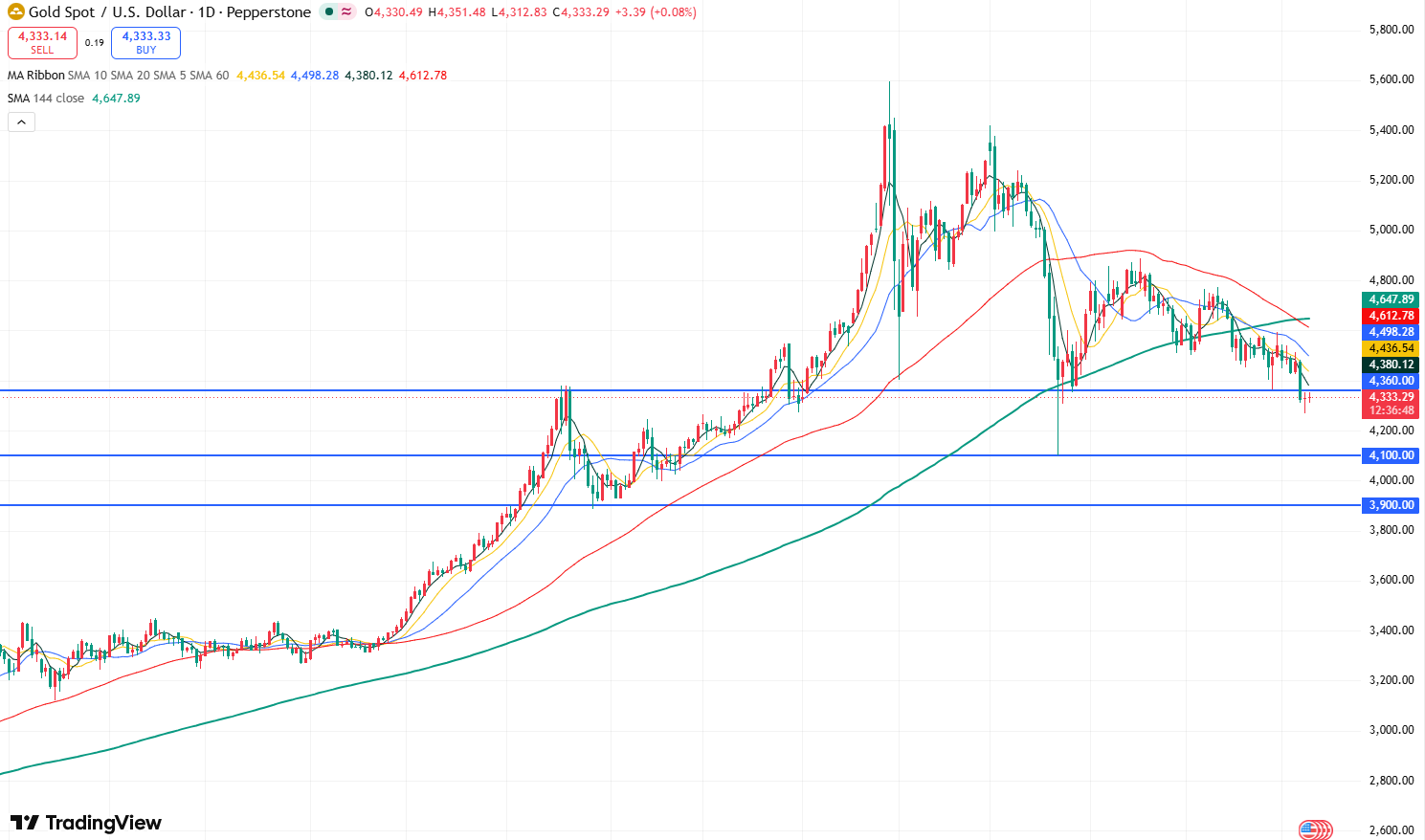
Gold Price Daily Chart, Source: TradingView
For gold ( XAUUSD ), market transmission should be understood through real interest rates. Although gold acts as an anti-inflation asset, in the current environment, if CPI drives up U.S. Treasury yields and the dollar, gold is conversely prone to pressure. Gold has recently weakened due to strong non-farm payrolls and rising rate-hike expectations; if CPI exceeds expectations again, gold prices may continue to decline, further testing the key support level at $4,100. Only when CPI is lower than expected and real interest rates fall will gold be expected to rebound.
Recommended Articles


