

Would a Strategy Bitcoin Sale Plunge Crypto into a Deep Freeze?
TradingKey – Bitcoin plunged into a fresh liquidation crisis in early December, following a brief late-November rebound, as internal cracks emerged that questioned key institutional support. Unlike October's multi-billion dollar forced liquidation event, which was primarily driven by external shocks, this year-end Bitcoin downturn also saw internal dissent, with questions arising over 'DAT bellwether' Strategy's (formerly MicroStrategy) 'Bitcoin conviction.'
On Monday, December 1, cryptocurrencies experienced their largest liquidation wave since the '1011' crypto market's previous major forced liquidation event in October. Approximately $1 billion in leveraged crypto positions were liquidated. Bitcoin's price fell by as much as 8% intraday, breaching $84,000.
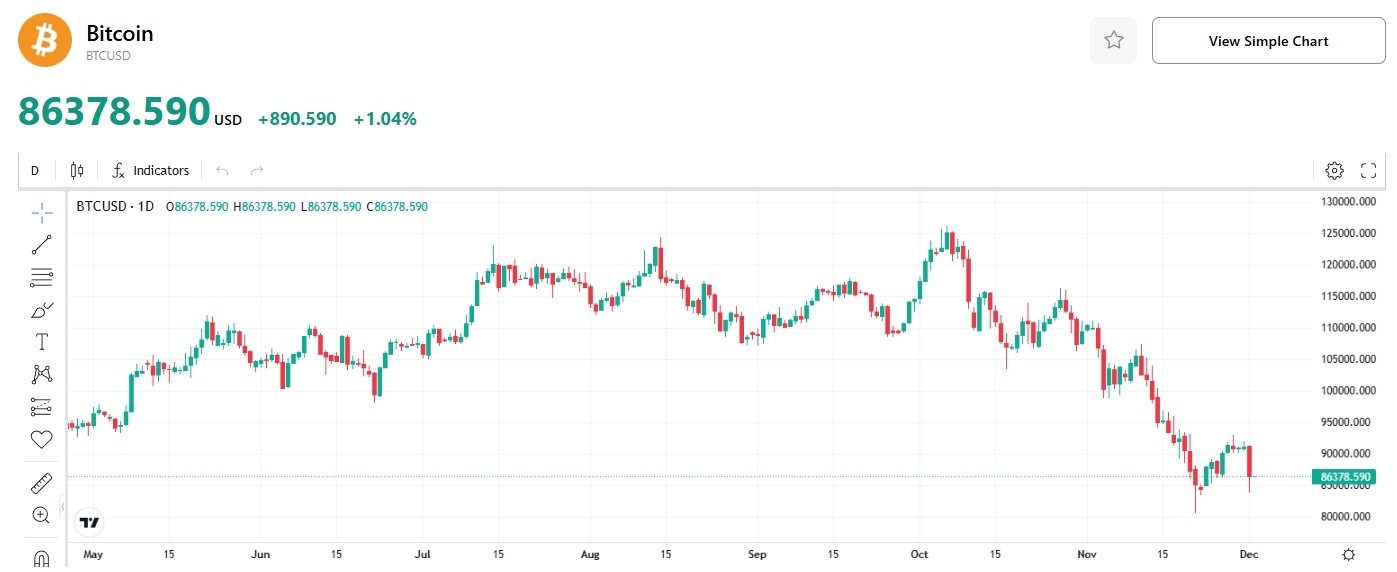
Bitcoin Price Chart, Source: TradingKey
Even as the Federal Reserve's hawkish rhetoric softened, Bank of Japan Governor Kazuo Ueda's hint at a December policy rate hike was seen as a new trigger for surging global liquidity pressures. Consequently, Bitcoin, which lacks independent drivers and is increasingly reliant on interest rate expectations, became a prime target for sell-offs.
December Marks Return to Risk Aversion
Analysts pointed out that, the market entered a risk-off mode in early December. The crypto market's biggest concerns were limited inflows into Bitcoin ETFs and a lack of dip buyers.
SosoValue data shows that spot Bitcoin ETFs have seen four consecutive weeks of net outflows since the week of October 31, totaling $4.34 billion. The largest Bitcoin ETF by net asset value recorded $2.34 billion in net outflows last month.
According to The Block, monthly spot trading volume on centralized exchanges (CEXs) in November dropped 27% to $1.59 trillion from $2.17 trillion in October, marking its weakest level since June this year. DefiLlama data indicated that decentralized exchange (DEX) trading volumes hit their lowest since June, falling from $568.43 billion in October to less than $400 billion.
Kronos Research noted that as the market shifted from October's frenzy to November's flatness, crypto asset volatility dissipated, and market momentum slowed. The decline in trading volume stemmed from profit-taking after the rally and a contraction in liquidity, a typical phenomenon as trader sentiment cools following a crowded ascent.
Beyond trading volumes, on-chain data also indicated a cool, even fragile, market.Regarding the slowdown in token accumulation by whales, or large Bitcoin holders, in recent weeks and the increase in purchases by small retail wallets, digital asset research firm BRN believesthis is a typical late-cycle pattern that exacerbates short-term fragility.
Is Strategy Destroying HODL Conviction?
Speaking of whale holdings, news that Strategy, the largest corporate holder of Bitcoin, might sell tokens to pay dividends sent shockwaves through the industry. Strategy anticipates its performance over the next 12 months could fluctuate between a $5.5 billion net loss and a $6.3 billion net profit if Bitcoin's price remains between $85,000 and $110,000 by year-end.
Gold bug Peter Schiff vehemently attacked Strategy's business model, which he described as "issuing stock to raise capital, buying approximately 4% yielding Treasuries, then issuing debt and preferred stock at an 8%-10% cost, ultimately to gamble on Bitcoin." Schiff claimed the latest plan marks the beginning of Strategy's end.
While Strategy founder Michael Saylor pledged that the newly established $1.4 billion reserve was intended to supplement Bitcoin reserves, Schiff argued that Saylor was forced to sell shares not to increase Bitcoin holdings, but merely to acquire U.S. dollars to cover interest and dividend payments. He called the stock "broken" and the business model "fraudulent."
Strategy, which spearheaded Bitcoin purchases almost weekly, ignited a wave of crypto treasury companies this year.However, now under operational and financial pressure, its wavering 'HODL' conviction could trigger a cascade of selling among its imitators.
FalconX sees $80,000 as Bitcoin's next key support level, while crypto treasury firm BNB Plus is bearish, targeting $60,000. Both firms indicate that the crypto market's pain is far from over.
Bitcoin's Fundamentals Hold Up
With major buyers turning into sellers and limited new capital inflows, Standard Chartered Bank's multi-month forecast of Bitcoin reaching $200,000 by the end of 2025 appears increasingly out of reach. Optimistically, however, some analysts maintain that Bitcoin's fundamentals have not fundamentally changed, attributing recent weakness to liquidity pressures.
The Kobeissi Letter stated thateven if cryptocurrencies have entered a technical bear market, it is a structural rather than a fundamental decline. Over the past two years, financial conditions have eased from their most restrictive levels since 2001.
Furthermore, over 90% of global central banks either cut rates or held them steady in the past 12 months—the highest proportion since 2020-2021—suggesting "global monetary policy has never been this loose."
The outcome of the Federal Open Market Committee (FOMC) meeting, to be announced by the Federal Reserve on December 10, offers a glimmer of hope for crypto investors. Traders are betting on an 87.2% probability of a rate cut in December, a significant rebound from 30% in late November.
BRN anticipates intense two-way conflict in the period ahead. For Bitcoin's price to regain stability, it needs to reclaim $90,000, along with seeing clear positive inflows into BTC ETFs and on-chain liquidity.
Recommended Articles


