

Gold retreats from six-week top amid positive risk tone; downside remains cushioned
- Gold drifts lower on Tuesday as a positive risk tone undermines traditional safe-haven assets.
- Rising December Fed rate cut bets keep the USD depressed and support the precious metal.
- Traders also seem reluctant and opt to wait for this week’s US macro data for a fresh impetus.
Gold (XAU/USD) attracts some sellers during the Asian session on Tuesday and moves away from its highest level since October 20, around the $4,264-4,265 region, touched the previous day. A generally positive tone around the equity markets undermines demand for traditional safe-haven assets and exerts some pressure on the precious metal. The commodity, however, shows some resilience below the $4,200 mark and recovers slightly from the daily low, warranting some caution for bearish trades and before positioning for a deeper corrective slide.
The growing acceptance that the US Federal Reserve (Fed) will lower borrowing costs again fails to assist the US Dollar (USD) to capitalize on the overnight modest bounce from a two-week low. This, in turn, is seen as a key factor that continues to act as a tailwind for the non-yielding Gold. Traders also seem reluctant to place aggressive bets and opt to wait for this week's important US macro releases, including the US Personal Consumption Expenditure (PCE) Price Index, for more cues about the Fed's rate-cut path and placing fresh directional bets.
Daily Digest Market Movers: Gold bulls move to the sidelines amid receding safe-haven demand
- Asian equity markets begin the day on a positive note after the previous day's selloff, undermining demand for the traditional safe-haven Gold on Tuesday. The commodity, however, reverses an Asian session dip to sub-$4,200 levels amid dovish Federal Reserve expectations and the bearish sentiment surrounding the US Dollar.
- Traders ramped up their bets for further policy easing by the US central bank following the recent comments from several Fed officials. Adding to this, the recent tepid US economic data suggests that growth in the world's largest economy is cooling and reaffirms market expectations for another interest rate cut by the Fed in December.
- In fact, the Institute for Supply Management (ISM) reported on Monday that its Manufacturing PMI for November fell to 48.2 from 48.7 in the previous month. The reading missed estimates and pointed to a slowdown in the manufacturing sector, which could potentially impact the overall economy and keep the USD bulls on the defensive.
- On the geopolitical front, US envoy Steve Witkoff and Russian President Vladimir Putin are expected to hold talks in Moscow on Tuesday to discuss the Trump administration's proposal to end the war in Ukraine. This comes after Ukraine's negotiator Rustem Umerov said that significant progress had been achieved in the latest Florida talks.
- However, US Secretary of State Marco Rubio noted that more work remains to be done towards ending the war. Furthermore, Ukrainian President Volodymyr Zelensky was seeking support from European allies amid fears that the US plan reads like a wishlist for Moscow. This keeps geopolitical risks in play and supports the XAU/USD pair.
- Traders now look forward to this week's important US macro releases, including the ADP report on private-sector employment and the US Personal Consumption Expenditure (PCE) Price Index. The crucial data will influence expectations about the Fed's rate-cut path, which, in turn, will drive the USD and provide a fresh impetus to the commodity.
Gold technical setup suggests that a slide below $4,200 could be seen as a buying opportunity
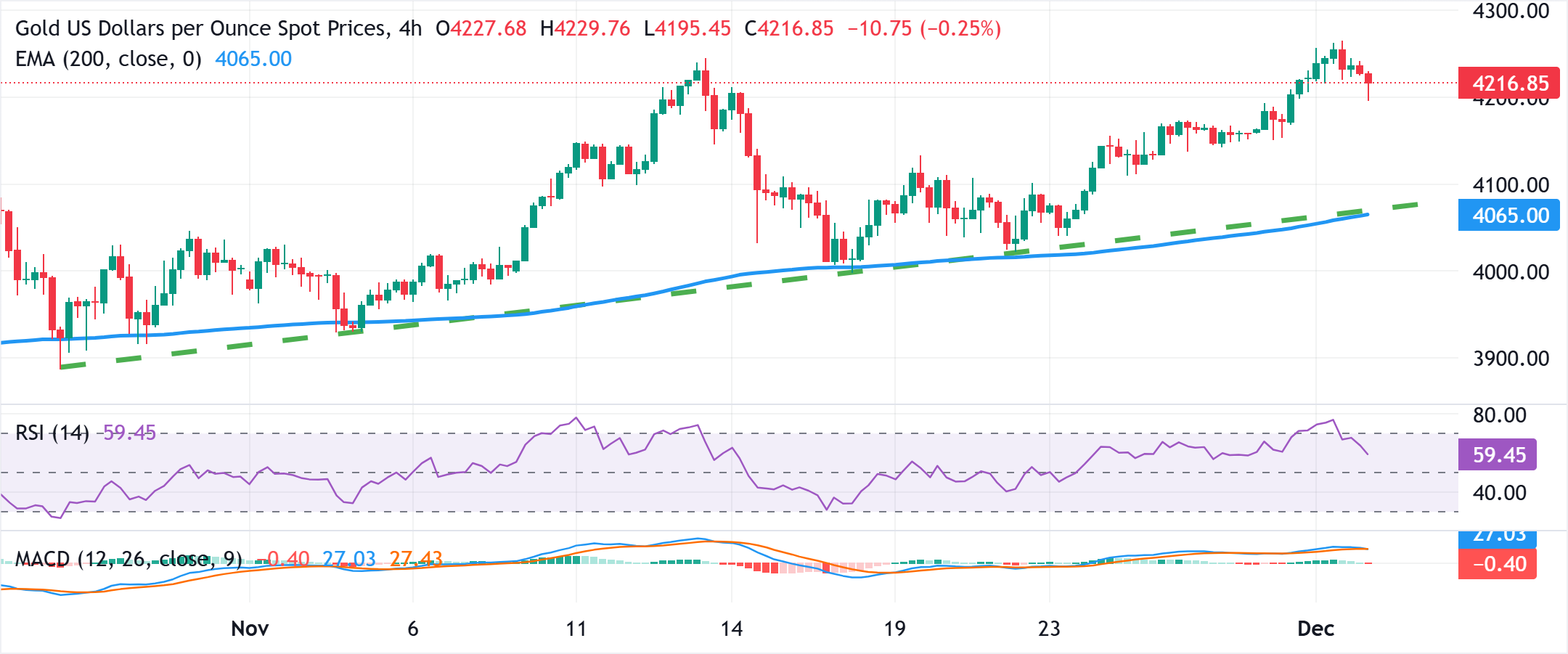
The near-term bias seems tilted in favor of the XAU/USD bulls. Given that oscillators on 4-hour/daily charts are holding in positive territory, any further weakness below the $4,200 mark could be seen as a buying opportunity and find decent support near the $4,155-4,153 region. The latter should act as a key pivotal point, which, if broken, could drag the Gold price to the $4,100 mark en route to the $4,065 confluence – comprising the 200-period Exponential Moving Average (EMA) on the 4-hour chart and an ascending trend-line extending from late October.
On the flip side, momentum beyond the overnight swing high, around the $4,264-4,265 region, will reaffirm the constructive outlook and allow the Gold price to reclaim the $4,300 round figure. Some follow-through buying should pave the way for additional gains towards the $4,340-4,345 intermediate hurdle en route to the all-time peak, around the $4,380 region, touched in October.
Gold FAQs
Gold has played a key role in human’s history as it has been widely used as a store of value and medium of exchange. Currently, apart from its shine and usage for jewelry, the precious metal is widely seen as a safe-haven asset, meaning that it is considered a good investment during turbulent times. Gold is also widely seen as a hedge against inflation and against depreciating currencies as it doesn’t rely on any specific issuer or government.
Central banks are the biggest Gold holders. In their aim to support their currencies in turbulent times, central banks tend to diversify their reserves and buy Gold to improve the perceived strength of the economy and the currency. High Gold reserves can be a source of trust for a country’s solvency. Central banks added 1,136 tonnes of Gold worth around $70 billion to their reserves in 2022, according to data from the World Gold Council. This is the highest yearly purchase since records began. Central banks from emerging economies such as China, India and Turkey are quickly increasing their Gold reserves.
Gold has an inverse correlation with the US Dollar and US Treasuries, which are both major reserve and safe-haven assets. When the Dollar depreciates, Gold tends to rise, enabling investors and central banks to diversify their assets in turbulent times. Gold is also inversely correlated with risk assets. A rally in the stock market tends to weaken Gold price, while sell-offs in riskier markets tend to favor the precious metal.
The price can move due to a wide range of factors. Geopolitical instability or fears of a deep recession can quickly make Gold price escalate due to its safe-haven status. As a yield-less asset, Gold tends to rise with lower interest rates, while higher cost of money usually weighs down on the yellow metal. Still, most moves depend on how the US Dollar (USD) behaves as the asset is priced in dollars (XAU/USD). A strong Dollar tends to keep the price of Gold controlled, whereas a weaker Dollar is likely to push Gold prices up.
Recommended Articles


