


The Chili's Revival at Brinker International Is Beginning to Cool Off
Key Points
Chili's has become a go-to option for consumers seeking value without sacrificing the casual dining experience.
Brinker International's smaller, more upscale Maggiano's Little Italy chain is struggling with declining traffic and profitability.
Margin pressures are building due to rising food prices.
- 10 stocks we like better than Brinker International ›
Brinker International (NYSE: EAT) has excelled at driving traffic to its restaurant chains over the past couple of years. Since arriving in 2022, CEO Kevin Hochman has engineered an impressive turnaround of the company's flagship Chili's Grill & Bar concept, positioning it to outperform the average in the casual dining category.
As a result of his multiyear effort to improve operations and the brand's image, Chili's just recorded its 20th consecutive quarter of same-store sales growth.
Will AI create the world's first trillionaire? Our team just released a report on the one little-known company, called an "Indispensable Monopoly" providing the critical technology Nvidia and Intel both need. Continue »
While Hochman deserves credit for simplifying the menu and kitchen operations, the social media team may have actually kicked things off after a TikTok video featuring Chili's mozzarella sticks went viral during the fourth quarter of its fiscal 2024. This was followed by the first quarter of traffic growth for Chili's since Hochman's arrival, and the customers just kept coming.
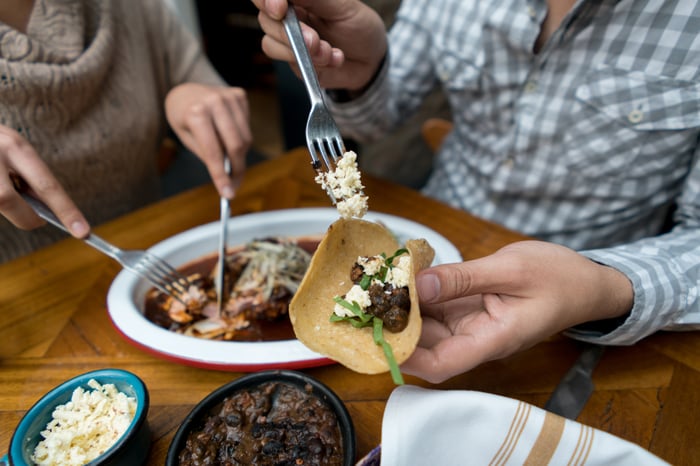
Image source: Getty Images.
Chili's continues to deliver
Management's focus on core menu offerings like burgers and fajitas while avoiding the constant rotation of limited-time deals has worked. The "3 for Me" value platform, which starts at $10.99 for a three-course meal, has been particularly effective at attracting customers from lower-income households, a demographic that many competitors are losing.
At the height of the turnaround in the second and third quarters of its fiscal 2025, Chili's posted same-store sales growth of 31.4% and 31.6%, respectively.
This year, growth on a percentage basis has slowed as the chain has lapped those monster quarters. In April, Brinker's reported that Chili's had same-store sales growth of 4% in its fiscal third quarter after posting 8.6% growth in its fiscal 2026 Q2, which ended Dec. 24, 2025.
While the days of double-digit percentage growth may be behind Chili's, if you've been following restaurant stocks for the past year or so, you're aware that its results in the current macroeconomic environment could've been far worse.
Margin pressure is beginning to build
Despite strong operations from the larger of its two chains (Chili's has over 1,500 locations, while its Maggiano's Little Italy chain has just 51), Brinker is not immune to industrywide cost pressures. Restaurant operating margins declined by 50 basis points year over year in the third quarter.
While the company has used menu price increases to cover some of these costs, the most recent quarter revealed a potential shift in traffic trends. Customer traffic at Chili's turned slightly negative by 1.2%, with the 4% same-store sales growth driven primarily by a 4.6% increase in price.
The pressure is even more pronounced at Maggiano's, which continues to be a drag on overall performance. The brand posted negative comparable sales of 4.6% in the third quarter, driven by a 10% decline in customer traffic.
While the Italian chain represents a small piece of the pie, along with its franchise operations, Brinker needs all of its assets to contribute as Chili's growth normalizes in the 3% to 5% range.
Last year, Hochman stepped in as interim president, installing new leadership and a "Back to Maggiano's" strategy to address the issues, but it will take time to turn the corner at that chain, particularly given its higher price point.
Food inflation is expected to reach mid-single-digit percentages in the second half of the fiscal year, led by higher beef prices. Chili's will need to prove that its traffic trends can stabilize while management continues to find efficiencies to offset rising costs.
Brinker's trades at a forward price-to-earnings ratio of around 13, which is a reasonable valuation, but with high gas prices likely to further weigh on consumer discretionary spending, investors may want to be patient as Hochman attempts to reinvigorate Maggiano's.
Should you buy stock in Brinker International right now?
Before you buy stock in Brinker International, consider this:
The Motley Fool Stock Advisor analyst team just identified what they believe are the 10 best stocks for investors to buy now… and Brinker International wasn’t one of them. The 10 stocks that made the cut could produce monster returns in the coming years.
Consider when Netflix made this list on December 17, 2004... if you invested $1,000 at the time of our recommendation, you’d have $445,672!* Or when Nvidia made this list on April 15, 2005... if you invested $1,000 at the time of our recommendation, you’d have $1,280,566!*
Now, it’s worth noting Stock Advisor’s total average return is 948% — a market-crushing outperformance compared to 206% for the S&P 500. Don't miss the latest top 10 list, available with Stock Advisor, and join an investing community built by individual investors for individual investors.
See the 10 stocks »
*Stock Advisor returns as of June 9, 2026.
Bryan White has no position in any of the stocks mentioned. The Motley Fool has no position in any of the stocks mentioned. The Motley Fool has a disclosure policy.
Recommended Articles


