


BofA Suggests US Stock Profit-Taking: 70% of Bear Market Signals Triggered, Are Tech Stocks Still a Buy?
TradingKey - Recently, following a strong rally in U.S. stocks driven by AI, semiconductors, and mega-cap tech stocks, market divergence is widening significantly. Bank of America ( BAC) recently warned that approximately 70% of the bearish warning signals it tracks have been triggered, a proportion comparable to the average level seen before the seven S&P 500 market tops since 1990. The BofA strategy team, led by Savita Subramanian, believes there are currently too many red flags in U.S. stocks and suggests investors consider moderate profit-taking rather than continuing to chase highs indiscriminately.
As of the close on June 8, the S&P 500 index stood at 7,405.72 points, up about 8.2% year-to-date, while the Nasdaq has gained roughly 11.6% this year. On the surface, U.S. stocks remain in a strong range, but the S&P 500 plummeted 2.6% last Friday, marking its largest single-day drop since October last year, with AI-related stocks also seeing a sharp correction. While there was some recovery on Monday, this pattern of sharp pullbacks followed by quick bounces suggests the market has become increasingly sensitive to high valuations and crowded trades.
Why is BofA advising profit-taking?
Bank of America’s core assessment is that U.S. stocks are already exhibiting many characteristics typical of historical peaks. The report notes that of 20 valuation metrics for the S&P 500, 17 indicate statistical overvaluation, and 8 are even higher than levels seen during the dot-com bubble.
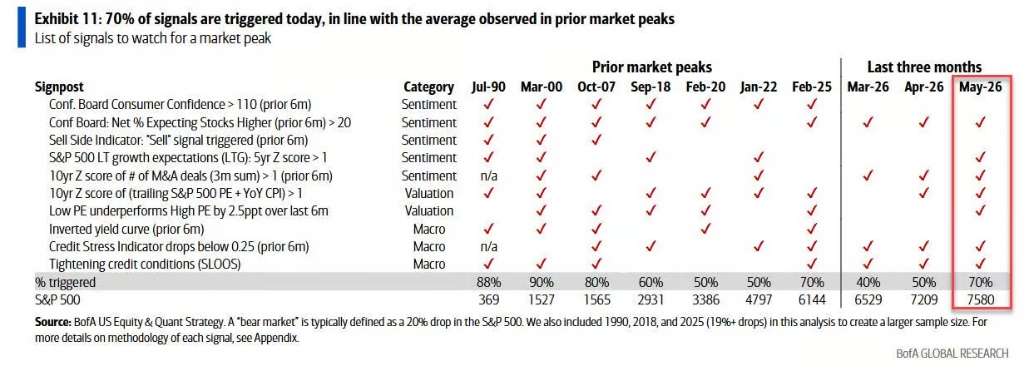
High valuations alone do not lead to a 100% chance of a decline, but the current rally is too dependent on mega-cap tech stocks and AI trades. BofA believes the S&P 500 has become excessively concentrated in large technology companies, and high P/E ratios, overly optimistic growth expectations, and performance divergence within the tech sector are all red flags for the current market.
This implies that the market rally’s "breadth" is not strong. The index appears to remain at high levels, but the gains are actually driven primarily by a few AI, semiconductor, and mega-cap technology leaders. Once these leaders experience profit-taking, the index may lack sufficient sector rotation to offset the decline.
Meanwhile, tech stock volatility has intensified recently. Market data show the Philadelphia Semiconductor Index plunged over 10% last Friday, its largest single-day drop since March 2020 and the fourth-largest since records began in 1994. Robust U.S. jobs data pushed up bond yields, fueling concerns that the Federal Reserve’s next moves could be more hawkish, further weighing on risk appetite.
Additionally, the current U.S. interest rate environment is unfriendly to the market. Following stronger-than-expected May non-farm payrolls, market sentiment regarding higher rates for longer has intensified significantly. The upcoming CPI data this week may also dictate the tone of the Fed’s next policy phase. If inflation remains hot and Treasury yields climb, it will directly compress the valuations of growth stocks.
What does a 70% bear market signal mean?
The triggering of the '70% Bear Market Signpost' does not mean the market will immediately enter a bear market. More accurately, it indicates that U.S. equities have entered a high-risk zone. Historically, when a cluster of similar warning indicators is triggered, the market is often nearing a tactical top, resulting in a less favorable risk-reward ratio.
Bank of America maintained its year-end S&P 500 target of 7,100, which reportedly implies a potential downside of approximately 4.5% to 6% from its closing price at the time. In other words, BofA is not forecasting a crash but rather suggesting that upside at the index level is limited and that downside risks are beginning to outweigh potential gains.
For investors, it is important to clarify that a 70% bear market signal does not mean a total liquidation of holdings. Strategically, the 70% signal should be interpreted as a prompt to 'reduce aggression.' It suggests the market is no longer suitable for blindly chasing rallies or using high leverage to bet on single themes, but it does not mean opportunities are absent across the board. BofA recommends looking at lower-valuation, previously neglected stocks and sectors, such as Financials, Healthcare, and parts of the Consumer Discretionary sector.
In fact, market opinions remain divided. Morgan Stanley still believes the bull market could continue, with the S&P 500 potentially reaching 8,000 by year-end. Investopedia reported that some institutions see the recent decline in tech stocks as a 'buy-the-dip' opportunity, arguing that corporate earnings and AI capital expenditures continue to support the market.
Citi's stance is also relatively moderate. Its 'Bear Market Checklist' shows that U.S. market risk signals are at their highest levels since 2008 but have not yet reached the extremes seen before a typical bear market. Consequently, Citi does not recommend that investors completely abandon 'buy-the-dip' strategies.
Are technology stocks still worth buying?
Tech stocks remain worth watching, but the investment logic has shifted. For some time, as long as a company was associated with concepts such as AI, computing power, chips, or cloud computing, the market was willing to grant a valuation premium; however, against the backdrop of U.S. equities continuously hitting record highs, investors now need to distinguish between "true beneficiaries" and "sentiment-driven rallies".
The first category worth long-term attention consists of tech leaders with strong earnings and cash flows. Major cloud computing, AI chip, and semiconductor equipment companies, as well as those with clear order support, are still likely to benefit from the AI capital expenditure cycle. As long as financial results continue to materialize, high valuations remain somewhat justified.
The second category requiring caution includes AI concept stocks that have experienced excessive short-term gains and overstretched valuations, yet have not delivered on profits. These stocks exhibit the greatest elasticity when market sentiment is high, but they are also the most susceptible to sharp pullbacks when Treasury yields rise or capital begins to take profits.
A third set of opportunities may come from sectors outside of tech that benefit indirectly from AI. Bank of America previously suggested that for those concerned about an AI bubble, attention could be shifted to indirect beneficiaries like electrification, power grid infrastructure, metals, and defense, as these industries are propelled by AI data center expansion and growing energy demand, while their valuation volatility may be lower than that of high-flying AI stocks.
Recommended Articles


