


The Surprising Reason the SpaceX IPO Could Be Fueling the Bitcoin Sell-Off
Key Points
Megacap initial public offerings are attracting investor capital, which could be weighing on Bitcoin demand.
Flows into exchange-traded funds act as a mechanized lever that can pull asset prices higher and push them lower.
Buying Bitcoin requires a long-term mindset.
- 10 stocks we like better than iShares Bitcoin Trust ›
On June 5, Bitcoin (CRYPTO: BTC) fell below $60,000 for the first time since September 2024 in lockstep with a broader decline in tech stocks that dragged the Nasdaq Composite (NASDAQINDEX: ^IXIC) down 4.2% for its worst day of 2026. Bitcoin is down more than 20% during the past month.
Here's the surprising reason the planned SpaceX initial public offering (IPO) could be partially to blame for the crypto sell-off, as well as a look at whether Bitcoin is a good buy now.
Will AI create the world's first trillionaire? Our team just released a report on the one little-known company, called an "Indispensable Monopoly" providing the critical technology Nvidia and Intel both need. Continue »

Image source: Getty Images.
Bitcoin ownership extends far beyond crypto wallets
In the early days of Bitcoin, the primary way to own it was through cold storage -- which is a cryptocurrency wallet that is not connected to the internet. This private set of keys provides maximum security, but it is inconvenient to transfer and costly to exchange. Hot wallets gained popularity once low-cost platforms like Coinbase Global and Robinhood Markets made it easy for investors to buy and sell Bitcoin and exchange it for other cryptocurrencies.
As Wall Street's long-term confidence in Bitcoin grew, so did institutional adoption and the methods investors could use to get access to Bitcoin. One of the biggest events in Bitcoin's recent history came on Jan. 5, 2024, when BlackRock (NYSE: BLK) launched the iShares Bitcoin Trust ETF (NASDAQ: IBIT). The fund buys and holds Bitcoin in an exchange-traded fund (ETF) -- collecting a 0.25% fee for doing so. The iShares Bitcoin Trust ETF opened the floodgates to Bitcoin ownership, providing an easy way to own Bitcoin through a brokerage account and, more importantly, through individual retirement accounts (IRAs).
The fund has attracted a deluge of capital. As of June 4, it held 774,434.1 Bitcoins valued at $49.4 billion. Bitcoin's maximum supply is 21 million, and the current supply is about 20 million, meaning the ETF holds 3.7% of all the Bitcoins that will ever be mined.
Being able to buy and hold Bitcoin on multiple platforms effectively boosted Bitcoin's demand by making it more accessible. For context, assets in IRAs totaled $19.2 trillion at the end of 2025. Meaning that if Americans collectively put 6% of their IRA funds in Bitcoin, it would be roughly equal to the entire value of the cryptocurrency.
The double-edged sword of Bitcoin ETF ownership
The best long-term yardstick for measuring a company's progress is earnings growth. Companies with earnings that consistently grow generate a high return on capital and have a very good chance of being good investments. But Bitcoin doesn't have earnings, quarterly reports, or management teams to hold accountable. Rather, its price is driven by demand. And a great way to measure Bitcoin demand is to look at ETF flows.
Investors poured money into the iShares Bitcoin Trust ETF in 2024 and for most of 2025. But since the Bitcoin sell-off gained steam in November 2025, the iShares Bitcoin Trust ETF has experienced significant outflows.
Bitcoin hit an all-time high in October 2025, during which the iShares Bitcoin Trust ETF had $4.28 billion in inflows. In November 2025, it had $2.37 billion in outflows as the sell-off intensified. Until that point, the largest month of outflows was in February 2025, at just $167.4 million. May 2026 saw $1.32 billion in outflows. The ETF has already experienced $1.24 billion in outflows less than a week into June 2026.
ETFs can work for and against Bitcoin. When inflows are pouring in, the iShares Bitcoin Trust ETF uses investor money to buy Bitcoin in the spot market, driving demand. And when outflows are rising, the fund sells Bitcoin on the spot market to return money to shareholders in cash -- creating downward pressure on Bitcoin's price.
The vacuum of SpaceX
Investing involves opportunity costs. Buying a stock requires exchanging money you could have spent today for an opportunity to have more money in the future. Similarly, investing in a cryptocurrency rather than stocks, bonds, Treasury Bills, or precious metals incurs an opportunity cost.
With Bitcoin failing to serve as a good hedge against inflation and not offering a yield for generating passive income, some investors may have become frustrated by its declining returns. Especially as Bitcoin has continued to fall while the Nasdaq and gold have performed exceptionally well during the past year.
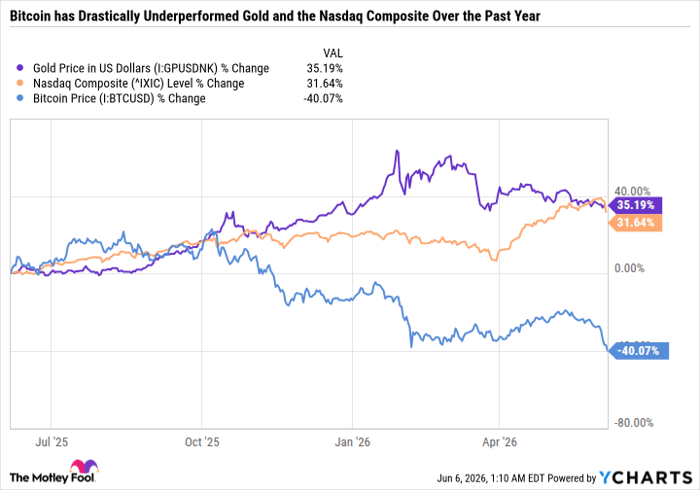
Gold Price in US Dollars data by YCharts.
Another factor that could be adding to the Bitcoin sell-off is the SpaceX IPO. Since SpaceX filed its Form S-1 with the Securities and Exchange Commission on May 20, Bitcoin has fallen 20.7% at the time of this writing.
SpaceX plans to raise $75 billion at a $1.77 trillion valuation for the company, making it one of the world's biggest. It has a unique lockup policy that will let insiders sell shares much sooner than the traditional 180-day waiting period. This new policy could quickly increase the shares available for public trading, known as the float, far past $75 billion in the coming months.
Although SpaceX won't be added to the S&P 500 for at least 12 months after it goes public, it may still get added to the Nasdaq-100 (the 100 largest nonfinancial companies by market cap on the Nasdaq exchange) shortly after going public and will be in high demand from ETFs that don't use the S&P 500 as a benchmark.
SpaceX will generate demand for capital normally allocated to Bitcoin ETF flows. What's more, Anthropic and OpenAI are both expected to go public later this year, which will attract even more capital, potentially away from other asset classes.
In sum, the institutionalization of Bitcoin expanded demand beyond a niche asset class -- driving Bitcoin's price higher. However, Bitcoin's price is now vulnerable to Wall Street and corporate sentiment rather than crypto-only investors. Institutions may be less interested in Bitcoin during a period when three high-profile companies are hitting public markets in a matter of months.
Integrating Bitcoin into a diversified portfolio
The Bitcoin sell-off is a good time for investors to decide what role (if any) they want Bitcoin to play in their portfolios. Some investors may find Bitcoin's attributes as a secure, decentralized, transferable store of value with a limited supply and independent of any government-controlled (fiat) currency appealing and worthy of allocating a small percentage of their portfolio to.
However, because gold has proven to be a better hedge against inflation and has real-world use cases, some investors may prefer to fill that role with gold instead of Bitcoin, whereas others may want to own Bitcoin alongside other cryptocurrencies with more practical use cases in decentralized finance and smart contracts.
In sum, blockbuster IPOs may not be the sole cause of the Bitcoin sell-off, but they are certainly not doing any favors for Bitcoin demand. So, investors should ensure they are buying Bitcoin with an investment horizon of at least five years, alongside a diversified portfolio of other assets to filter out the noise in case the sell-off intensifies.
Should you buy stock in iShares Bitcoin Trust right now?
Before you buy stock in iShares Bitcoin Trust, consider this:
The Motley Fool Stock Advisor analyst team just identified what they believe are the 10 best stocks for investors to buy now… and iShares Bitcoin Trust wasn’t one of them. The 10 stocks that made the cut could produce monster returns in the coming years.
Consider when Netflix made this list on December 17, 2004... if you invested $1,000 at the time of our recommendation, you’d have $443,191!* Or when Nvidia made this list on April 15, 2005... if you invested $1,000 at the time of our recommendation, you’d have $1,258,838!*
Now, it’s worth noting Stock Advisor’s total average return is 941% — a market-crushing outperformance compared to 206% for the S&P 500. Don't miss the latest top 10 list, available with Stock Advisor, and join an investing community built by individual investors for individual investors.
See the 10 stocks »
*Stock Advisor returns as of June 9, 2026.
Daniel Foelber has the following options: short June 2026 $45 puts on iShares Bitcoin Trust. The Motley Fool has positions in and recommends Bitcoin, BlackRock, and iShares Bitcoin Trust. The Motley Fool recommends Coinbase Global. The Motley Fool has a disclosure policy.
Recommended Articles


