


Are You a New Stock Market Investor in June 2026? Here's Warren Buffett's Advice.
Key Points
The Oracle of Omaha has a track record of exceptional capital allocation, but his suggestion for most people is surprisingly simple.
There’s a low-cost investment vehicle out there that provides instant exposure to the S&P 500 index.
If you’re worried about the market’s current valuation, consider a dollar-cost average strategy.
- 10 stocks we like better than Vanguard S&P 500 ETF ›
Over the past 30 years, the S&P 500 index has generated a total return of 1,770% (as of June 5). That performance supports the view that the stock market is one of the best asset classes for growing your wealth. A starting sum of $10,000 in this benchmark in June 1996 would be worth $187,000 today. The gains have been even more remarkable over the past decade.
Understanding that this kind of performance can have a profound impact on your financial well-being, it might be time for new investors to direct some of their savings into the stock market. Given how daunting it might seem, it can be difficult to figure out where to even begin.
Will AI create the world's first trillionaire? Our team just released a report on the one little-known company, called an "Indispensable Monopoly" providing the critical technology Nvidia and Intel both need. Continue »
Here's where Warren Buffett comes into the picture. The great investor is also a wonderful educator whose advice is well worth considering. If you're new to the stock market this month, listen to the Oracle of Omaha's suggestion.
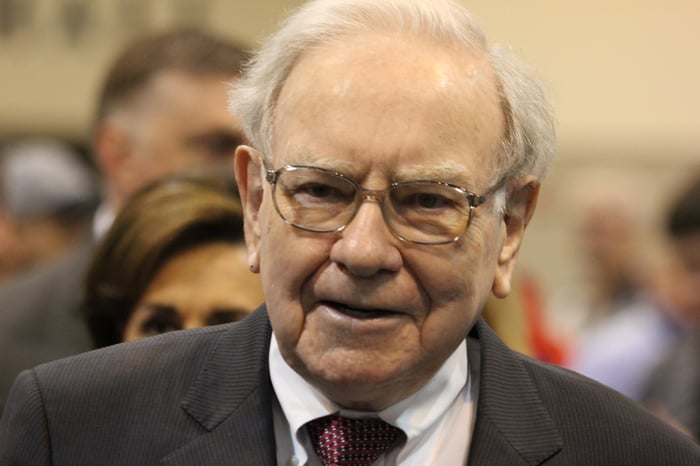
Image source: The Motley Fool.
Keep it simple
Buffett is known for his exceptional capital allocation skills, having compounded Berkshire Hathaway's share price at a yearly clip of almost 20% for six decades before stepping down as CEO at the end of last year. But his advice for most investors is surprisingly simple. He basically recommends buying a low-cost S&P 500 index fund.
This perspective probably comes from the fact that the average person doesn't have the time, ability, or desire to want to pick individual stocks and manage a portfolio. And it stems from the inability of expert fund managers to beat the market.
Active management strategies generally have a bad track record. Data shows that the vast majority of large-cap fund managers lose to the S&P 500 over the long term. Whether these professionals trade too often, charge high fees, or just aren't adept portfolio managers, that is a very disappointing statistic. And it makes you wonder why more investors don't choose the passive route.
Consider this popular exchange-traded fund
One of the best options is the Vanguard S&P 500 ETF (NYSEMKT: VOO). It comes with an extremely low expense ratio of 0.03%. Over several years and decades, investors will pay a significantly smaller amount than what active managers typically charge. The difference leaves more money in your pocket.
This ETF tracks the S&P 500 index, so its holdings match the benchmark. The top five holdings are Nvidia, Apple, Microsoft, Amazon, and Alphabet, clearly showing a strong position within the information technology sector. Investors will certainly be exposed to all things related to artificial intelligence.
However, it's worth pointing out that this ETF contains all sectors of the economy. It's essentially a hassle-free method for gaining broad market exposure.
Maintain a long-term perspective
The S&P 500 index today trades at a historically expensive valuation, calling into question the benchmark's return potential. While the phenomenal trailing 10-year total return of 316% might not repeat, I think it still makes sense to invest in the stock market.
Profit growth and margins are robust. And the companies leading the charge, some of which were mentioned already, are some of the most dominant businesses the world has ever seen, so they deserve the market's appreciation.
If the current valuation is a real concern for you, then consider adopting a dollar-cost averaging (DCA) strategy. By doing so, you could allocate fresh savings to the market on a monthly or quarterly basis, virtually eliminating the need to accurately assess what the correct starting valuation should be.
And even adding small sums of money to a DCA approach can lead to tremendous long-term results. Let's say you initially invest $10,000 into the Vanguard S&P 500 ETF. But then every single month, you invest $100. Assuming the historical 10% annualized total return holds true, you'd have $382,000 after 30 years. Of course, if you put more money to work, the ending figure will be larger.
Should you buy stock in Vanguard S&P 500 ETF right now?
Before you buy stock in Vanguard S&P 500 ETF, consider this:
The Motley Fool Stock Advisor analyst team just identified what they believe are the 10 best stocks for investors to buy now… and Vanguard S&P 500 ETF wasn’t one of them. The 10 stocks that made the cut could produce monster returns in the coming years.
Consider when Netflix made this list on December 17, 2004... if you invested $1,000 at the time of our recommendation, you’d have $443,191!* Or when Nvidia made this list on April 15, 2005... if you invested $1,000 at the time of our recommendation, you’d have $1,258,838!*
Now, it’s worth noting Stock Advisor’s total average return is 941% — a market-crushing outperformance compared to 206% for the S&P 500. Don't miss the latest top 10 list, available with Stock Advisor, and join an investing community built by individual investors for individual investors.
See the 10 stocks »
*Stock Advisor returns as of June 9, 2026.
Neil Patel has positions in Vanguard S&P 500 ETF. The Motley Fool has positions in and recommends Alphabet, Amazon, Apple, Berkshire Hathaway, Microsoft, Nvidia, and Vanguard S&P 500 ETF. The Motley Fool has a disclosure policy.
Recommended Articles


