


Where Will PayPal Stock Be in 5 Years?
Key Points
PayPal shaped the industry by being the first major online wallet to market.
This mature business, however, has few barriers to entry.
The online payment space is also now very crowded with strong competition.
- 10 stocks we like better than PayPal ›
After a miserable post-pandemic performance, a small number of stock pickers are finally turning bullish on PayPal (NASDAQ: PYPL). Michael Burry (of Big Short fame) is one of them. And priced at less than 10 times this year's expected per-share profits of $5.31 in the shadow of the company's first-quarter revenue improvement of 7%, this interest is understandable. New CEO Enrique Lores may well be leading a turnaround that's not yet priced in.
An honest look at where this online payments company and its stock are likely to be five years from now, however, isn't particularly exciting.
Will AI create the world's first trillionaire? Our team just released a report on the one little-known company, called an "Indispensable Monopoly" providing the critical technology Nvidia and Intel both need. Continue »

Image source: Getty Images.
A turnaround can only do so much
Something is clearly changing for the better with PayPal. Although the company's earnings guidance for the year now underway suggests profits are poised to slump just a small bit, analysts are looking for more slow, single-digit top-line growth for this year and next, when earnings are expected to begin growing again. While PayPal is already established in markets like online checkout, consumer financial services (such as Venmo), and traditional brick-and-mortar payment acceptance, which Lores touts as target points for a turnaround, he at least seems to have some fresh ideas about how the company can further penetrate these businesses by leveraging its current size and brand name.
There's a reason, however, the analyst community still only considers this ticker a hold, with a consensus price target of $49.87 that's only about 10% above the stock's present price. That is, there's no real barrier to entry into any of the businesses PayPal is in. Indeed, many of the platforms that are chipping away at PayPal's dominance -- like Apple's Apple Pay and Block's Cash App -- are already well positioned in many consumers' minds. Projections from credit card outfit Capital One suggest Apple Pay's user base is poised to grow from 65.6 million to more than 84 million between last year and 2030, for instance, outpacing any user growth PayPal has experienced of late, or is likely to muster in the foreseeable future.
Not enough reward to justify what's admittedly modest risk
Don't misread the message. Morningstar's long-term forecast suggests PayPal's annual revenue is on pace to grow from last year's $33.2 billion to $41.1 billion by 2030. That's not horrible. It's annualized revenue growth of a little over 4%. Earnings are expected to grow at about the same pace.
In the grand scheme of things, though, progress that barely outpaces inflation isn't particularly impressive either.
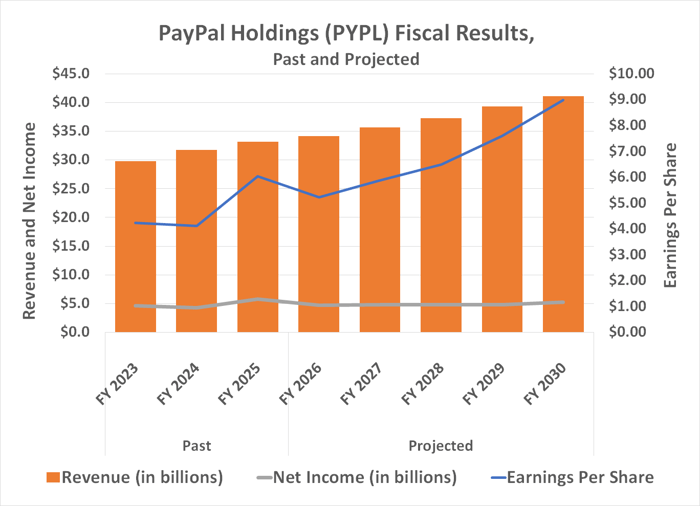
Data source: Morningstar. Chart by author.
In answer to the question, then -- although it's just a guess based on what we can see right now -- is that PayPal's stock would do well to reach $55 a share within the next five years. That's an improvement that merely matches its revenue and earnings growth. It's unlikely investors are ever going to be willing to give this ticker a premium valuation beyond its current one, simply because it's unlikely the company will be able to grow its share of the crowded, now-mature online payments market that has no real barrier to entry.
More to the point, there are too many better investment options out there for anyone other than speculators to bother with this one.
Should you buy stock in PayPal right now?
Before you buy stock in PayPal, consider this:
The Motley Fool Stock Advisor analyst team just identified what they believe are the 10 best stocks for investors to buy now… and PayPal wasn’t one of them. The 10 stocks that made the cut could produce monster returns in the coming years.
Consider when Netflix made this list on December 17, 2004... if you invested $1,000 at the time of our recommendation, you’d have $477,813!* Or when Nvidia made this list on April 15, 2005... if you invested $1,000 at the time of our recommendation, you’d have $1,320,088!*
Now, it’s worth noting Stock Advisor’s total average return is 986% — a market-crushing outperformance compared to 208% for the S&P 500. Don't miss the latest top 10 list, available with Stock Advisor, and join an investing community built by individual investors for individual investors.
See the 10 stocks »
*Stock Advisor returns as of May 24, 2026.
James Brumley has no position in any of the stocks mentioned. The Motley Fool has positions in and recommends Apple, Block, and PayPal. The Motley Fool recommends Capital One Financial and recommends the following options: short June 2026 $50 calls on PayPal. The Motley Fool has a disclosure policy.
Recommended Articles


