


What's the Better Dividend Stock Today: AbbVie or Pfizer?
Key Points
Pfizer's dividend yield is far higher than AbbVie's, but the key issue is whether the payout is safe.
AbbVie has been a dividend growth beast for several years, and that trend could very well continue.
- 10 stocks we like better than Pfizer ›
AbbVie (NYSE: ABBV) and Pfizer (NYSE: PFE) are two top healthcare stocks, and they're investments that can generate a ton of dividend income for your portfolio.
AbbVie, which yields 3.2%, has been a dividend growth beast for decades and has been doing a good job of growing its business even after its top-selling drug Humira lost patent protection. It has proven to be a good long-term dividend investment to hang on to.
Will AI create the world's first trillionaire? Our team just released a report on the one little-known company, called an "Indispensable Monopoly" providing the critical technology Nvidia and Intel both need. Continue »
Pfizer offers a higher yield of 6.7%, but it's a bit riskier, given that it's still in the midst of trying to get back to growth and is facing some daunting patent cliffs in the near future. For investors, the pressing issue is whether the business is on the right track and if its dividend is indeed safe.
Below, I'll look at which of these dividend stocks is the better option for income investors right now.

Image source: Getty Images.
Is Pfizer's dividend really safe?
The biggest question for income investors when analyzing these two stocks may come down to the safety of Pfizer's payout. Regardless of the yield, if the dividend is in danger, what percentage Pfizer pays today may be meaningless, and thus, AbbVie's stock would be the better option by default.
The problem, however, is that you can't just look at Pfizer's payout ratio, which is over 100%, because there has been so much noise in its earnings in recent quarters. The company has gone through restructuring, and one-time expenses such as impairment charges have weighed on its bottom line.
Its free cash flow has totaled $9.5 billion over the past four quarters, which is a bit lower than the $9.8 billion the company has paid in dividends during that time frame. But with Pfizer trimming costs and looking to become leaner, that shortfall may not be terribly concerning, at least not yet, anyway.
AbbVie's payout, on the other hand, is far more secure. The company's free cash has totaled nearly $20 billion over the past 12 months, which is comfortably higher than the $11.8 billion it has paid in dividends during that stretch.
AbbVie's dividend growth could make up for its lighter yield
Although Pfizer's yield is higher today, investors shouldn't overlook the potential for AbbVie's dividend income to rise. The company has been generous with dividend increases over the years, and given how much room it has in its free cash flow, there may be some more significant increases to its dividend in the coming years.
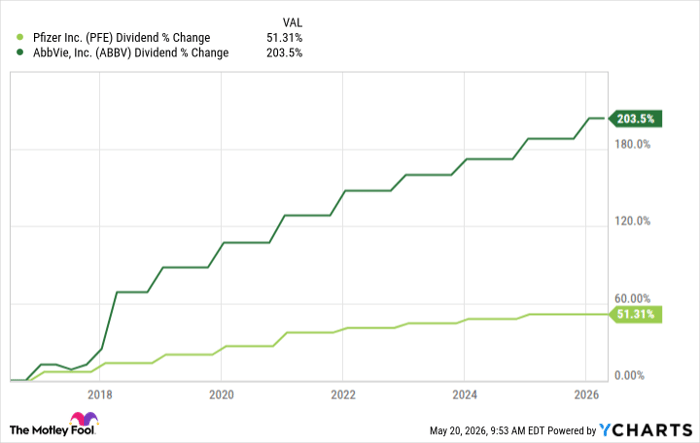
PFE vs ABBV dividend growth data by YCharts
While AbbVie's dividend has been rising sharply over the years, Pfizer has not been keeping pace at all. And if its growth plans don't pan out and the business struggles, any increases may be minor at best. Continued rate hikes are also encouraging signs from management about a company's future growth.
AbbVie is the better dividend stock to buy right now
I've had the painful experience of seeing a dividend stock I owned cut its payout quite literally a week before I was planning to sell it. And when that happened, it nosedived -- quickly. That's why when it comes to dividends, a safe payout has to be the top priority. If it's risky and if there's even a small chance it could be cut, you may be better off avoiding it. As a turnaround play, Pfizer can be an intriguing stock to own, but it's not the type of investment that's going to be suitable for risk-averse investors who are primarily focused on the dividend income it may generate.
AbbVie's yield may be lighter, but it's still higher than the S&P 500 average of 1.1%, and with potentially significant increases in the years ahead, there's plenty of incentive to buy and hold. It's the long term that matters with dividends, not today, and not where the dividend yield is right this very moment. And that's why AbbVie is the safer all-around option for dividend investors right now.
Should you buy stock in Pfizer right now?
Before you buy stock in Pfizer, consider this:
The Motley Fool Stock Advisor analyst team just identified what they believe are the 10 best stocks for investors to buy now… and Pfizer wasn’t one of them. The 10 stocks that made the cut could produce monster returns in the coming years.
Consider when Netflix made this list on December 17, 2004... if you invested $1,000 at the time of our recommendation, you’d have $477,813!* Or when Nvidia made this list on April 15, 2005... if you invested $1,000 at the time of our recommendation, you’d have $1,320,088!*
Now, it’s worth noting Stock Advisor’s total average return is 986% — a market-crushing outperformance compared to 208% for the S&P 500. Don't miss the latest top 10 list, available with Stock Advisor, and join an investing community built by individual investors for individual investors.
See the 10 stocks »
*Stock Advisor returns as of May 24, 2026.
David Jagielski, CPA has no position in any of the stocks mentioned. The Motley Fool has positions in and recommends AbbVie and Pfizer. The Motley Fool has a disclosure policy.
Recommended Articles


