


Gold holds steady as traders weigh Middle East optimism against hawkish Fed outlook
- Gold stabilizes as easing Middle East tensions improve market sentiment.
- A softer US Dollar offers support, but higher-for-longer interest rate expectations limit upside.
- Technically, bearish momentum remains in place as XAU/USD struggles below the Bollinger midline near $4,500.
Gold (XAU/USD) shows signs of stabilization on Tuesday, supported by a softer US Dollar (USD) and lower Oil prices as signs of de-escalation in the Middle East war improve market sentiment.
At the time of writing, XAU/USD is trading around $4,339, little changed on the day after falling to its lowest level in nearly two and a half months on Monday.
US President Donald Trump said negotiations with Iran are in the "final throes" and that an agreement could be reached within days. "We're in the final throes of what will be a very, very good deal," Trump told reporters on Tuesday. He added that the Strait of Hormuz would reopen as soon as a deal is finalized.
The comments added to optimism after Iran and Israel agreed to halt strikes following weekend hostilities.
However, Gold is struggling to capitalize on the softer US Dollar as growing expectations that the Federal Reserve (Fed) could keep interest rates higher for longer continue to weigh on the non-yielding metal.
The next hurdle for Gold: US inflation
Traders are staying on the sidelines ahead of the US Consumer Price Index (CPI) report due on Wednesday.
Inflation has drifted further away from the central bank's 2% target, as higher Crude Oil prices following the outbreak of the war in the Middle East in late February have added to inflationary pressure. Annual CPI rose to 3.3% in March and 3.8% in April, with economists expecting a further increase to 4.2% in May.
A stronger-than-expected reading would cement bets on a rate hike later this year and increase pressure on Gold, which tends to perform well in a low-interest rate environment. In contrast, a softer inflation reading could allow the Fed to remain patient and trigger a short-term rebound in the precious metal.
Still, gains may be capped as markets remain convinced that interest rates will stay elevated for longer, unless a US-Iran agreement leads to a sustained decline in Oil prices and eases inflation concerns.
Technical analysis: XAU/USD stabilizes, but the technical picture remains fragile
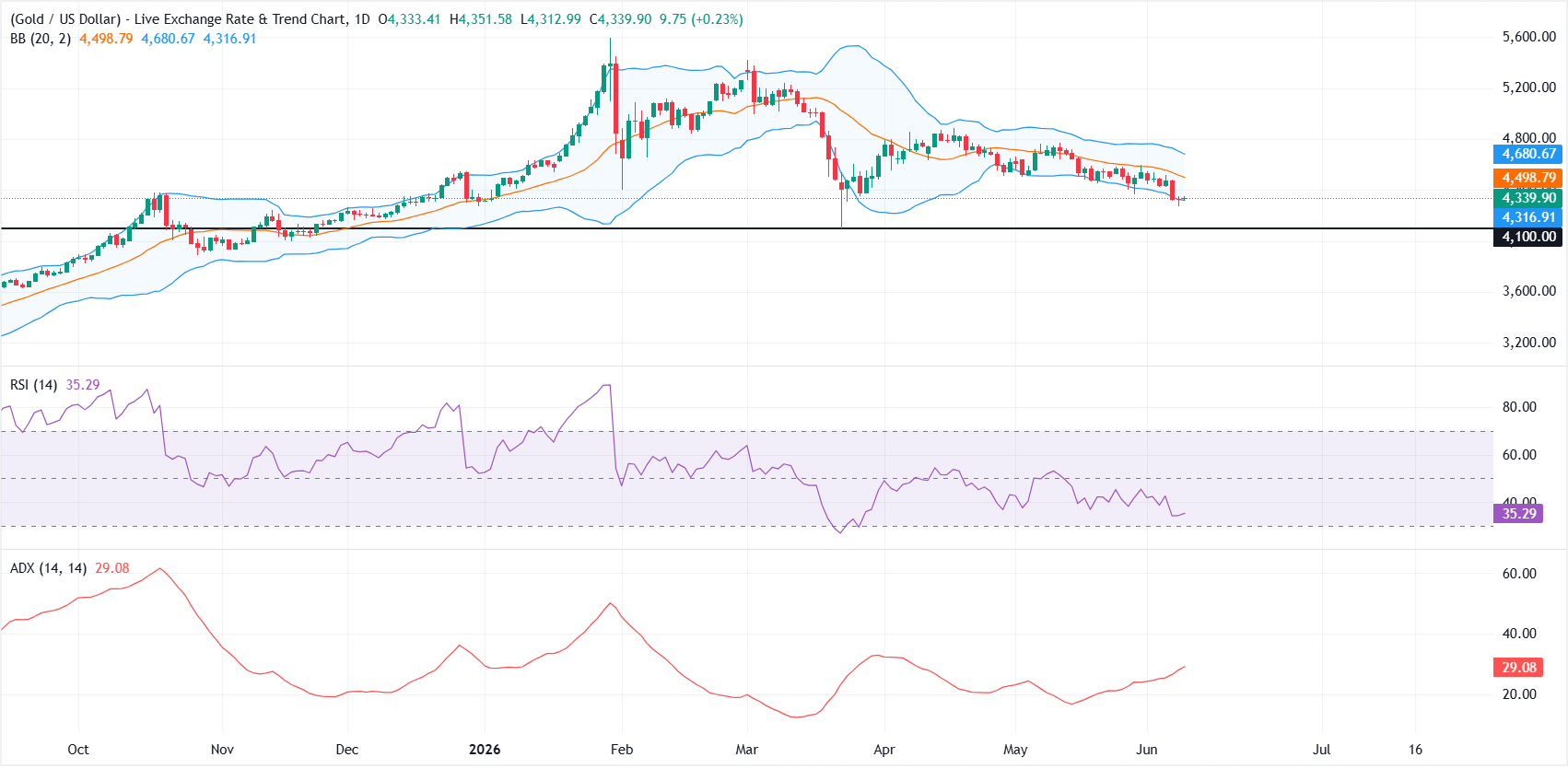
On the daily chart, XAU/USD remains in a broadly bearish configuration, holding below the 20-period Bollinger Simple Moving Average at roughly $4,498 while only marginally above the lower band near $4,317, suggesting price is pressed against downside volatility support. The Relative Strength Index (RSI) hovers around 36, pointing to weak, bearish-leaning momentum, while the Average Directional Index (ADX) near 29 hints that the prevailing downtrend retains moderate strength.
On the upside, initial resistance emerges at the Bollinger middle band around $4,498, with a further cap at the upper band near $4,680 if buyers attempt a corrective bounce. On the downside, immediate support is seen at the Bollinger lower band around $4,317, and a break below this area could expose the next horizontal floor near $4,100, where buyers may again try to stem the decline.
(The technical analysis of this story was written with the help of an AI tool.)
Inflation FAQs
Inflation measures the rise in the price of a representative basket of goods and services. Headline inflation is usually expressed as a percentage change on a month-on-month (MoM) and year-on-year (YoY) basis. Core inflation excludes more volatile elements such as food and fuel which can fluctuate because of geopolitical and seasonal factors. Core inflation is the figure economists focus on and is the level targeted by central banks, which are mandated to keep inflation at a manageable level, usually around 2%.
The Consumer Price Index (CPI) measures the change in prices of a basket of goods and services over a period of time. It is usually expressed as a percentage change on a month-on-month (MoM) and year-on-year (YoY) basis. Core CPI is the figure targeted by central banks as it excludes volatile food and fuel inputs. When Core CPI rises above 2% it usually results in higher interest rates and vice versa when it falls below 2%. Since higher interest rates are positive for a currency, higher inflation usually results in a stronger currency. The opposite is true when inflation falls.
Although it may seem counter-intuitive, high inflation in a country pushes up the value of its currency and vice versa for lower inflation. This is because the central bank will normally raise interest rates to combat the higher inflation, which attract more global capital inflows from investors looking for a lucrative place to park their money.
Formerly, Gold was the asset investors turned to in times of high inflation because it preserved its value, and whilst investors will often still buy Gold for its safe-haven properties in times of extreme market turmoil, this is not the case most of the time. This is because when inflation is high, central banks will put up interest rates to combat it. Higher interest rates are negative for Gold because they increase the opportunity-cost of holding Gold vis-a-vis an interest-bearing asset or placing the money in a cash deposit account. On the flipside, lower inflation tends to be positive for Gold as it brings interest rates down, making the bright metal a more viable investment alternative.
Recommended Articles


