


Trump Says "Total Victory Over Iran" in Two Weeks, Oil Prices to Slump, JPMorgan Warns Crude Inventories Face Shortage in June
TradingKey - On Monday ET, U.S. President Trump made a major statement during a telephone campaign event for South Carolina Senator Lindsey Graham, claiming that the U.S. will achieve a "complete victory" over Iran within the next two weeks, at which point international oil prices will fall significantly.
Trump stated in the announcement that the U.S. and Iran are currently in negotiations, that Iran wants to reach an agreement, and is willing to accept key conditions set by the U.S., including not possessing nuclear weapons.
He further emphasized: "I think we are winning this contest, and the real victory will come within the next two weeks. When we announce total victory, it will be a complete victory, and it's going to happen very soon. At that point, oil prices will drop sharply."
It is worth noting that this is not the first time Trump has suggested that major progress would be made "within two weeks." On April 7 of this year, the U.S. announced a ceasefire agreement with Iran, which was also initially set for "two weeks" to "allow both sides to complete negotiations on a final agreement to end the conflict." However, subsequent negotiations did not yield the expected progress, and clashes between the two parties continue to occur intermittently.
Ceasefire
Earlier, just as Trump made the aforementioned remarks, Iran and Israel announced a temporary suspension of reciprocal attacks, marking a pause in the most severe escalation of violence since the ceasefire took effect in April.
The Khatam al-Anbiya Central Headquarters of the Iranian Armed Forces issued a statement that day, declaring that following its response to Israel's recent military actions in southern Lebanon and the southern suburbs of Beirut, the Iranian armed forces have now concluded this round of military operations. Subsequently, a senior Israeli official stated that Israel had suspended strikes on Iran at the request of U.S. President Donald Trump.
However, both sides' ceasefire declarations are conditional. Iran emphasized that if Israel continues military operations in areas such as southern Lebanon or leads to further escalation, Iran will take "harsher and more powerful" follow-up measures. Israel stated that if Hezbollah continues to attack Israeli towns, Israel will resume strikes on the southern suburbs of the Lebanese capital, Beirut.
Although Trump has repeatedly claimed that the conflict is nearing an end, the U.S.-Israeli war against Iran has persisted for four months as of June.
Iran had previously refuted Trump's claims that a peace agreement was imminent and halted indirect negotiations with Washington last week.
Ebrahim Azizi, Chairman of the National Security and Foreign Policy Committee of the Iranian Parliament, stated in an interview that Iran is not opposed to advancing peace talks with the United States, but the U.S. must change its current conduct and demonstrate sincerity.
JPMorgan Warns of Pressure on Crude Oil Inventories in June
JPMorgan Chase ( JPM )'s Head of Commodities Research Natasha Kaneva noted in her latest report that as the Iran-Israel conflict enters its fourth month, Brent crude oil futures have stabilized at approximately $100 per barrel, with volatility receding significantly. Does this calm mean the worst has passed? Or is the market underestimating a delayed shock?
Kaneva’s answer is: buffer mechanisms such as declining oil demand and global production expansion have played a role in temporarily supporting prices, but the clock on inventory depletion continues to tick.
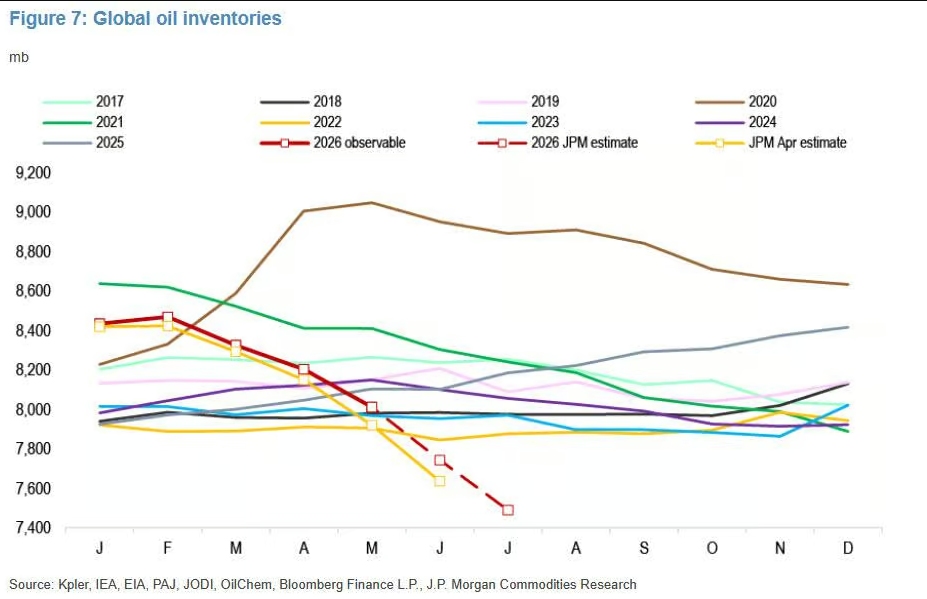
Since early March, global visible crude oil inventories have decreased by a cumulative total of approximately 460 million barrels. Analysts expect inventories to enter a stress zone in late June and approach operational floors by September.
The actual shipping situation in the Strait of Hormuz is also far more complex than surface data suggests. Although nominally under blockade, with visible ship traffic at only about 15% of pre-war levels, some vessels are quietly crossing the strait by turning off transponders or spoofing signals.
Analysts estimate that "shadow flows" through the strait in the second half of May were approximately 2.1 million barrels per day, but this figure is still far from sufficient to fill the gap—pre-war daily throughput in the Strait of Hormuz was around 16 million barrels.
Since early March, global visible inventories (including crude oil and refined products) have fallen by a cumulative total of approximately 460 million barrels, equivalent to a daily consumption of about 4.6 million barrels. OECD countries have released about 400 million barrels of strategic reserves to the market, roughly half of which has yet to arrive.
Even if an agreement is reached between the U.S. and Iran, it will take time for the Strait of Hormuz to resume navigation, and inventory depletion will persist. Analysts conclude that global inventories will enter a stress zone in late June and approach operational floors in September—consistent with previous forecasts.
JPMorgan’s base-case scenario predicts that the Strait of Hormuz will reopen in June, with Brent crude oil prices averaging around $100 per barrel for the full year, with the monthly average price dropping below triple digits only in December.
However, if the blockade of the strait continues, for every additional month of closure in the third quarter, the average price would rise by about $5; for every additional month in the fourth quarter, the average price would rise by about $15. The larger increase in the fourth quarter is primarily driven by accelerated inventory depletion—once the buffer disappears, price sensitivity to supply gaps will rise sharply.
Recommended Articles


